ESPR vs the Ecodesign Directive: What Actually Changed, and Why It Matters
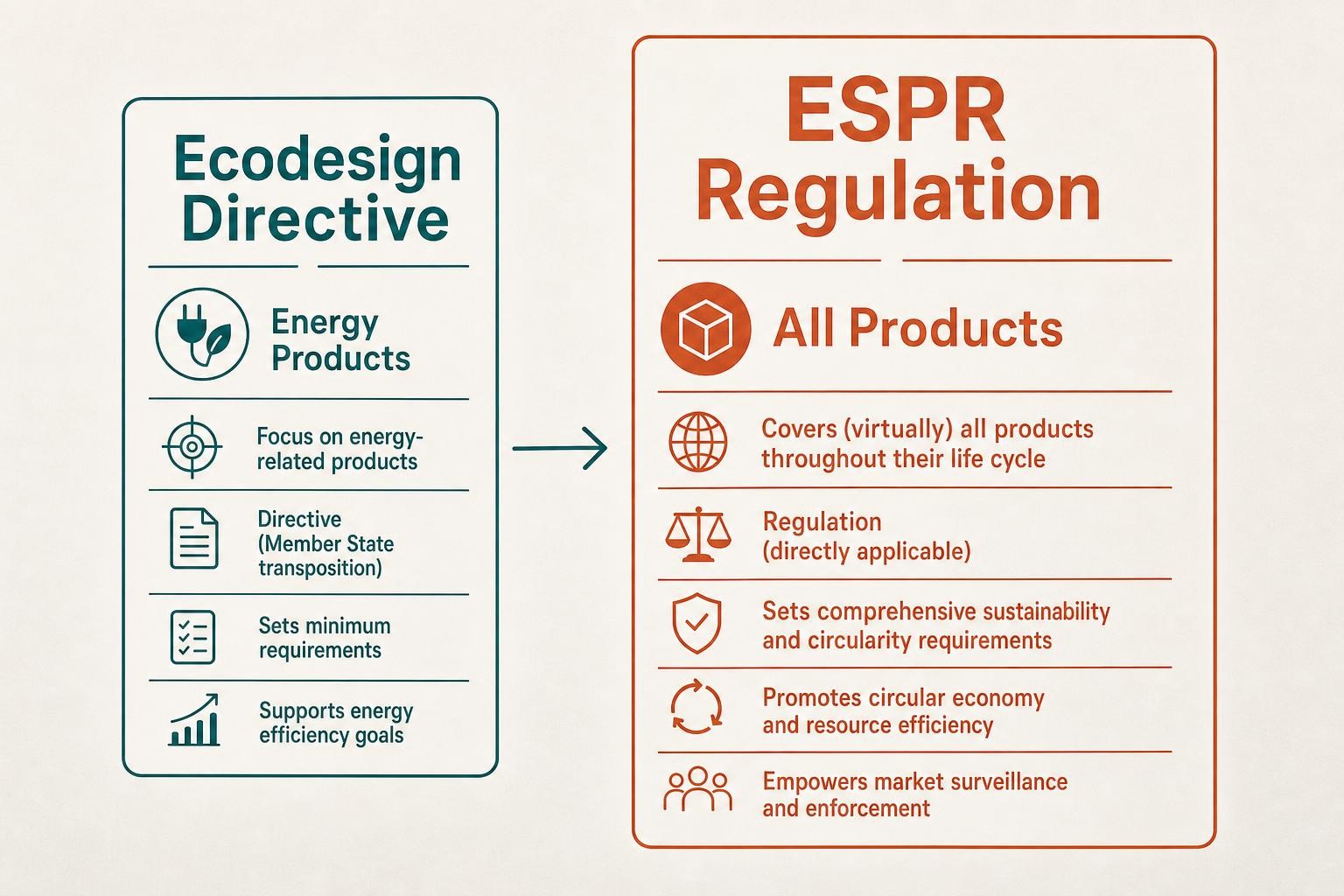
If you work in compliance, legal, or product development and someone has just handed you a document about ESPR, the first question you probably asked was: isn't there already an ecodesign law? There was. Regulation (EU) 2024/1781 - the Ecodesign for Sustainable Products Regulation (ESPR) - entered into force on 18 July 2024, formally repealing and replacing Directive 2009/125/EC, the original Ecodesign Directive. The two instruments share a name and a lineage, but they differ in scope, legal form, and the range of requirements they impose. Understanding those differences is the foundation for any serious ESPR compliance programme.
TL;DR: The old Directive covered energy-related products only, had to be transposed into 27 separate national laws, and focused almost entirely on energy efficiency. The new Regulation covers nearly all physical goods, applies uniformly across the EU from day one, and adds a full suite of circularity criteria alongside the energy rules.
Shift 1 - Scope: From Energy Products to Almost Everything
The Ecodesign Directive's defining characteristic was its boundary. The Ecodesign Directive 2009/125/EC was limited to energy-related products and focused primarily on energy efficiency. In practice, that meant appliances, lighting, motors, boilers, and similar equipment - its scope covered more than 40 product groups such as boilers, lightbulbs, TVs and fridges. That is a meaningful set of products, but it left the vast majority of physical goods on the EU market entirely outside the framework.
The ESPR removes that boundary almost entirely. Article 2 of the Regulation applies to "any physical good placed on the market or put into service, including components and intermediate products" - a substantial extension over Directive 2009/125/EC, which was limited to "energy-related products." The carve-outs are narrow and specific: the material scope includes all physical goods placed on the market or put into service, including components and intermediate products, with only a few product areas excluded, such as certain foods, pharmaceuticals, animals and special vehicles.
The practical implication is significant. A furniture manufacturer, a tyre producer, or a steel mill had no direct obligations under the old Directive. Under ESPR, all three sit within the framework's reach - even if the specific delegated act for their product category has not yet been adopted. Specific requirements for each product category become binding only once the Commission adopts the relevant delegated act, so the timing of obligations varies by sector. But the question of whether ESPR applies is now answered the same way for almost every physical product: yes, unless it falls within one of the named exclusions.
Shift 2 - Legal Form: From Directive to Regulation
The distinction between a directive and a regulation is not a technicality - it has direct consequences for how companies experience the law.
A directive sets an objective but leaves each member state to write its own national legislation to achieve it. The Ecodesign Directive had to be transposed into national law by 20 November 2010, and it set out a framework for the European Commission to lay down harmonised ecodesign minimum requirements for energy-related products sold in the EU. The word "harmonised" was always the aspiration, but transposition introduced variation. Member states were required to adopt national legislation to implement the directive, create authorities for market surveillance, and adopt penalties for infringements. In practice, that meant 27 different national acts, with differences in enforcement priorities, penalty structures, and administrative procedures.
A regulation, by contrast, is directly applicable. The shift from a directive to a regulation is not a technicality - it eliminates the variation in national implementations that allowed companies to exploit regulatory gaps between member states. ESPR as a framework regulation applies uniformly across the EU from its entry into force date. There is no transposition step, no waiting for a member state to publish its implementing act, and no scope for national variations in the core obligations.
For legal and compliance teams, this matters in two ways. First, there is a single authoritative text to work from - Regulation (EU) 2024/1781 as published in the Official Journal - rather than 27 national versions. Second, enforcement will be more consistent in principle, even if market surveillance authorities still operate at national level.
The product-specific implementing measures adopted under the old Directive do not disappear overnight. Under the ESPR's transitional provisions, existing implementing regulations adopted under Directive 2009/125/EC remain in force until they are individually repealed or replaced by new ESPR delegated acts. If your product already has an ecodesign implementing regulation (e.g. for motors, lighting, or household appliances), that measure continues to apply until the Commission updates it under the new framework.
Shift 3 - Criteria: Beyond Energy Efficiency to Full-Lifecycle Circularity
The Ecodesign Directive's primary lens was energy. In 2021, the Ecodesign Directive was responsible for a 10% reduction in energy consumption of regulated products, resulting in energy savings of €120 billion for consumers. That is a genuine achievement. But the European Commission recognised that products have environmental impacts beyond just energy use, and so proposed the ESPR as part of its Circular Economy Action Plan.
The ESPR's criteria menu is substantially wider. Performance requirements set minimum thresholds products must meet, covering parameters such as durability, reusability, repairability, energy and resource efficiency, recycled content, carbon footprint, and restrictions on substances that inhibit circularity. Energy efficiency remains on the list - it does not disappear - but it is now one parameter among many rather than the organising principle of the entire framework.
Two new tools give the broader criteria practical force. The Digital Product Passport (DPP) will make a product's composition, repairability score, recycled content, and compliance status machine-readable and accessible to supply chain actors, regulators, and recyclers - we cover the DPP in detail in a dedicated post. Separately, the ESPR introduces a ban on destroying certain unsold consumer goods, starting with large companies and textiles from 19 July 2026 - again covered in its own post.
What is worth noting here is the structural logic. The old Directive asked: how much energy does this product use? The ESPR asks: how does this product perform across its entire lifecycle - from material extraction through use, repair, and end-of-life? That is a fundamentally different question, and it requires a fundamentally different compliance approach.
A Side-by-Side Summary
| Dimension | Ecodesign Directive 2009/125/EC | ESPR — Regulation (EU) 2024/1781 |
|---|---|---|
| Legal instrument | Directive — transposed into national law by each member state | Regulation — directly applicable across the EU, no transposition |
| Entry into force | Transposition deadline: 20 November 2010 | 18 July 2024 |
| Product scope | Energy-related products only (e.g. appliances, lighting, motors) | Almost all physical goods, including components and intermediate products |
| Named exclusions | Means of transport | Food, feed, medicinal products, living organisms, certain vehicles, defence products |
| Primary criteria | Energy efficiency and energy consumption | Energy efficiency + durability, repairability, reusability, upgradability, recycled content, carbon footprint, substances |
| New compliance tools | None beyond product-specific implementing measures | Digital Product Passport (DPP) + ban on destroying unsold consumer goods |
| How requirements are set | Commission implementing measures per product group | Commission delegated acts per product group (same logic, broader criteria menu) |
| Transitional arrangements | N/A | Existing implementing measures under the Directive remain in force until replaced by ESPR delegated acts |
What to Do Now
If your product was already covered by the Ecodesign Directive, your immediate task is to confirm whether an ESPR delegated act has been adopted for your category yet - and if not, to continue complying with the existing implementing measure while monitoring the Commission's delegated act pipeline.
If your product was not covered by the old Directive - textiles, furniture, steel, aluminium, tyres, and many others - the ESPR is new territory. The framework regulation is already in force. The first ESPR Working Plan, adopted on 16 April 2025, identifies textiles, furniture, mattresses, tyres, iron and steel, and aluminium as priority product groups for the first delegated acts. Delegated acts for those categories are now in preparation, and the compliance clock is running.
The scope question - does ESPR apply to my product? - is almost always answered yes. The more useful question is when, and that depends on which delegated act covers your category. Our 2025-2030 ESPR Working Plan post maps out the Commission's sequencing in detail.
Related reading

What Happens to the Digital Product Passport After the First Sale? ESPR and the Second-Hand Market
ESPR's Digital Product Passport is written around the moment a product is placed on the market. But the passport is meant to last a product's whole life. Here's who carries it into resale, what refurbishers and remanufacturers must actually do, and where the obligations genuinely stop.

Your Ecodesign Implementing Regulation Didn't Lapse on 18 July 2024: The ErP-to-ESPR Migration Map
ESPR repealed Directive 2009/125/EC, but your ErP implementing regulations are still binding. Here's the transition map: what the 2026 and 2030 dates actually close, what migration adds, and what to do now.

SCIP Database and ESPR: Why Your DPP Substance Data Is a Different Beast Entirely
You've been filing SCIP notifications since 2021. ESPR's Digital Product Passport doesn't replace that obligation - it demands something structurally different. Here's what changes and what to do now.