Digital Product Passport for Aluminium: What the ESPR Means for Producers, Extruders, and Buyers

Aluminium is not an afterthought in the ESPR Working Plan. It is a named priority - selected explicitly because of its high recyclability potential and its strategic importance to EU supply resilience. But it sits on a later track than iron and steel, and its distinguishing regulatory challenge is not just carbon footprint. It is the recycling story: the enormous gap between primary and secondary production emissions, the difficulty of tracing scrap through mixed streams, and the alloy-contamination problem that makes "recycled content" far harder to verify for aluminium than for most other materials.
This post is a product-group deep dive. If you want a general introduction to what a DPP is, or how the recycled-content mechanism works under ESPR, those are covered in our earlier posts. Here we focus on what aluminium specifically means for the regulation - and what practitioners should be doing about it now.
Where Aluminium Sits in the ESPR Working Plan
The first ESPR Working Plan (COM(2025) 187), adopted on 16 April 2025, identifies six priority product groups for delegated acts: textiles, furniture, mattresses, tyres, iron & steel, and aluminium. Aluminium was chosen due to its high recyclability potential and its strategic importance in enhancing EU supply resilience. It is also listed not only as a final product but as an intermediate product - the logic being that regulating the material itself drives sustainability improvements across every downstream sector that uses it.
The indicative timeline matters, and the word indicative needs to be taken seriously. The ESPR Working Plan estimates the adoption of the delegated act for aluminium around 2027, with the corresponding DPP arriving in 2028-2029. These are planning estimates in a Commission working document, not fixed legal deadlines. Only two ESPR dates are actually fixed in the framework regulation itself: ESPR entered into force on 18 July 2024, and the EU Central DPP Registry must be operational by 19 July 2026. Everything else - including the aluminium delegated act - is indicative and subject to the pace of preparatory studies, stakeholder consultation, and Commission legislative capacity.
Iron and steel carries the earlier indicative date (around 2026), and the methodology being developed for that sector is expected to inform the aluminium work. Aluminium's preparatory studies are expected to begin in earnest during 2026, with the broader consultation process planned for that year and finalisation of the overall ESPR methodology expected by 2028.
Indicative ≠ fixed. The aluminium delegated act date (~2027) and DPP date (~2028–2029) are planning estimates from the ESPR Working Plan, not legally binding deadlines. Delays are possible — the battery passport delegated acts followed a similar pattern of slippage. Monitor the Ecodesign Forum and JRC preparatory study publications for the first concrete signals.
The Recycling Story: Why Aluminium Is Different
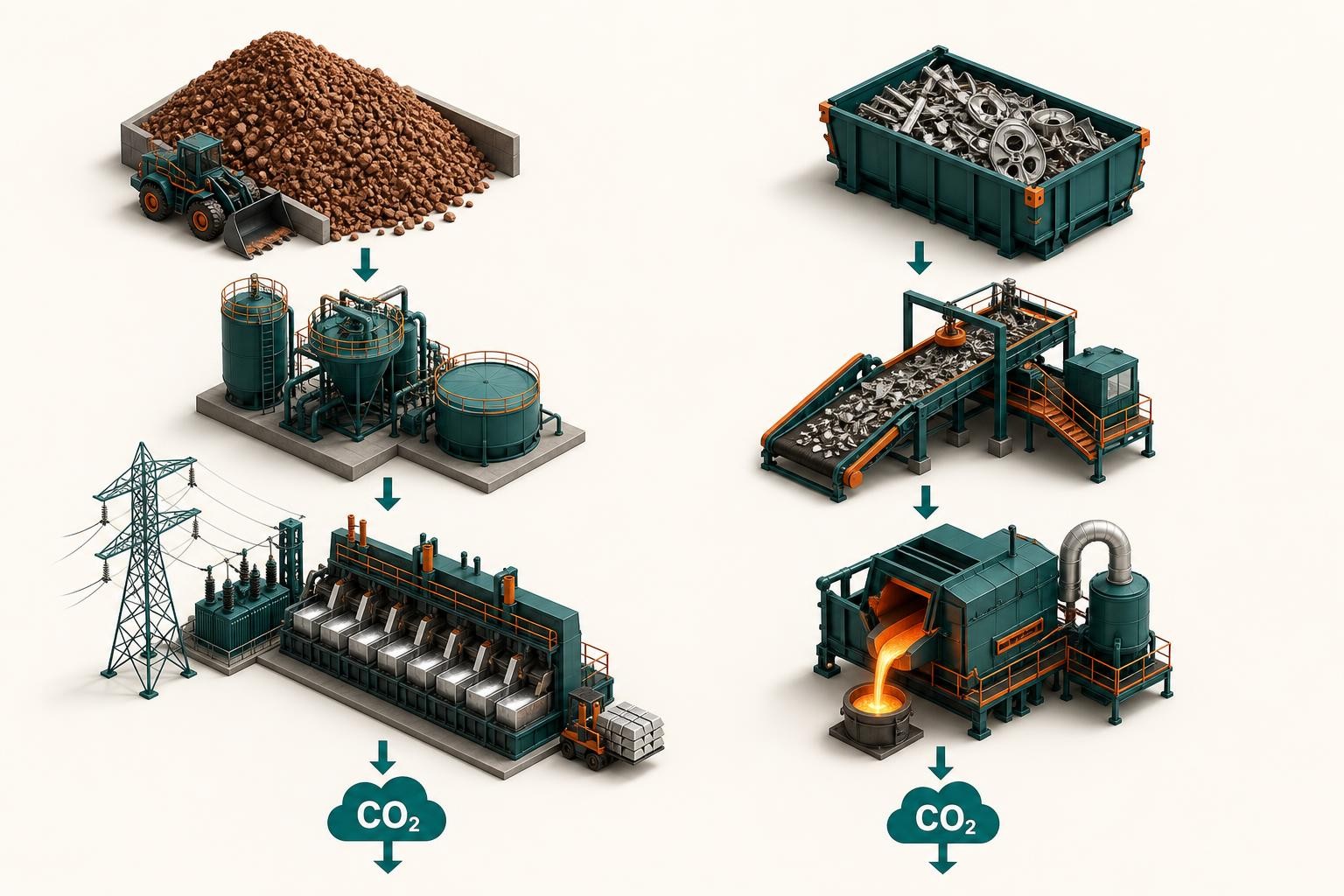
The carbon arithmetic for aluminium is stark. In 2022, the carbon footprint of global primary aluminium production (from mine to cast house) was 15.1 tonnes of CO₂e per tonne, while the carbon emissions for producing recycled aluminium (gate-to-gate) were 0.52 tonnes of CO₂e per tonne. That is a roughly 29:1 ratio - and it is the single most important number in the aluminium DPP story.
The energy requirement for primary aluminium is 15.7 MWh per tonne, while recycling requires only 0.8 MWh per tonne. Primary smelting via the Hall-Héroult process is electrolysis-intensive by design. That means the carbon footprint of primary aluminium is not fixed - it varies enormously depending on the electricity grid. In hydropower-based regions, one tonne of aluminium production causes less than 4 tonnes of CO₂ emissions, whereas in coal-centric areas the volume exceeds 20 tonnes per tonne. A European smelter running on Nordic hydro and a Chinese smelter running on coal-fired power are producing the same metal with radically different embedded emissions. The DPP will need to capture that distinction at the product level.
This is also why production route - primary versus secondary - will almost certainly be a mandatory data field in the aluminium DPP. It is not a proxy for quality; it is the single largest determinant of carbon intensity.
The Hard Part: Scrap, Alloy Contamination, and Traceability
Aluminium's recyclability is theoretically infinite - the metal does not degrade chemically through remelting. In practice, the recycling chain introduces a contamination problem that makes recycled-content verification genuinely difficult.
A challenge is that large amounts of scrap are post-consumer scrap, containing high levels of elemental contamination - iron is the most dangerous contaminant because it causes brittle and fragile intermetallic phases, which significantly impacts the mechanical characteristics of alloys. The standard industry responses to contamination are dilution with primary aluminium or downgrading to lower-grade casting alloys. Neither is a clean circularity story.
The distinction between pre-consumer scrap (process scrap from manufacturing, with known composition) and post-consumer scrap (end-of-life material from mixed sources, with uncertain composition) is therefore not a bureaucratic nicety - it is a material data point. Pre-consumer scrap from a controlled extrusion or rolling operation can be traced to a specific alloy designation. Post-consumer scrap from a mixed collection stream cannot, without additional sorting and analysis.
This creates a fundamental tension for any recycled-content requirement in the aluminium DPP:
- Mass-balance accounting allows a producer to allocate recycled-content attributes across output without physical segregation of scrap streams. It is operationally practical but does not guarantee that any specific tonne of product contains the claimed recycled input.
- Physical traceability - tracking specific scrap batches through to specific cast output - is technically possible for pre-consumer scrap in controlled environments, but extremely difficult for post-consumer scrap at scale.
Common barriers to traceability in aluminium scrap recycling include limited data availability, poor system integration, and high costs of implementing new systems. The enabling factors - digital product passports, advanced marking technologies, and alloy-specific tracking - are exactly what the ESPR DPP is intended to create. But the methodology for what counts as verified recycled content, and at what granularity, will be one of the most contested questions in the aluminium preparatory study.
What the Aluminium DPP Data Model Will Likely Need
No delegated act has been adopted. The data fields are not fixed. But the JRC-led methodology for DPP content - developed through the Ecodesign Forum and already applied to the iron and steel preparatory study - gives a clear signal of what to expect. Based on that methodology and the sector's specific characteristics, the aluminium DPP data model will almost certainly need to cover:
| Data Category | Likely Fields | Data Readiness Challenge |
|---|---|---|
| Product identity | Alloy designation (EN/AA series), product form (sheet, extrusion, cast, wire), batch/cast number, unique product identifier | Low — most producers already record this |
| Production route | Primary / secondary / mixed; facility location; smelting energy source (for primary) | Medium — route tagging is not always formalised at batch level |
| Recycled content | Recycled content % by weight; pre-consumer vs post-consumer split; scrap source documentation; mass-balance or physical traceability method | High — post-consumer scrap traceability is the hardest problem |
| Carbon footprint | Product carbon footprint (PCF) in kg CO₂e/tonne; system boundary; electricity source for primary smelting | Medium-high — PCF methodology for aluminium not yet standardised under ESPR |
| Environmental product data | EPD reference or LCA data; substances of concern; end-of-life recyclability information | Medium — EPDs exist but are not yet DPP-linked |
The JRC methodology applies a use-case-driven approach: it asks who needs the data (downstream buyers, recyclers, market surveillance authorities, consumers) and what decisions they need to make, then works backwards to define the minimum required fields. For aluminium, the recycler use case - knowing the alloy designation and scrap-input history of incoming material - is likely to be a significant driver of what gets mandated.
CBAM and the DPP: What Overlaps, and What Doesn't
The Carbon Border Adjustment Mechanism has been operating in its definitive regime since 1 January 2026 for covered aluminium goods. Many aluminium producers and importers have therefore spent the past two-plus years building embedded-emissions data infrastructure - supplier questionnaires, verified emissions calculations, production-route documentation. That work is not wasted. But it is not sufficient for ESPR DPP compliance either.
The structural difference is this:
CBAM is importer-facing and emissions-only. It requires the EU importer (or their authorised declarant) to report and pay for the embedded greenhouse gas emissions in covered goods. The data flows to the CBAM registry, is used for certificate calculation, and is accessible to customs and tax authorities. It does not travel with the product. It is not accessible to downstream buyers, recyclers, or market surveillance bodies. And it covers only greenhouse gas emissions - not recycled content, alloy composition, production route beyond what is needed for emissions calculation, or end-of-life data.
The ESPR DPP is product-level and wider in scope. It attaches to the product itself via a data carrier (QR code, GS1 DataMatrix, or RFID/NFC), travels through the supply chain, and provides differentiated access to different actor types - downstream buyers get material composition and PCF data; recyclers get alloy designation and end-of-life handling information; authorities get full technical documentation. The data model goes well beyond emissions.
CBAM data is not automatically identical to later ESPR DPP fields - but it creates a strong basis for carbon footprint, production route, electricity sourcing, processing stage, and supplier evidence. These are exactly the data domains that will matter for the aluminium DPP. The practical implication: producers who have built robust CBAM data pipelines have a head start on the carbon footprint and production-route components of the DPP. They still need to build the recycled-content, alloy-traceability, and end-of-life layers from scratch.
What Producers and Buyers Should Be Doing in 2026-2027
The delegated act is indicatively around 2027. Preparatory studies are beginning now. The Ecodesign Forum is the venue where methodology decisions are being made. This is the window to build data infrastructure before requirements are fixed - not after.
Every cast or batch should carry a production-route flag — primary, secondary, or mixed — as a structured data field, not a free-text note. If your ERP or MES does not support this today, add it. This is the single most consequential data point for the DPP carbon footprint calculation.
For each melt, record scrap inputs by source category: process scrap (pre-consumer, known alloy), purchased scrap (pre-consumer, declared alloy), and post-consumer scrap (mixed, with sorting method noted). Attach supplier declarations where available. Generic 'recycled content' claims without source documentation will not meet DPP verification standards.
If you have CBAM-compliant embedded-emissions data, map it to a product carbon footprint (PCF) format. CBAM uses a specific calculation methodology tied to the EU ETS; the ESPR DPP will likely require a PCF aligned to an ISO 14067 or EN 15804 framework. The overlap is significant, but the system boundaries and allocation rules may differ. Identify the gaps now.
Alloy designation (EN 573 for wrought, EN 1706 for cast) and product form (sheet, plate, extrusion profile, wire rod, ingot) should be captured at cast level and linked to the batch identifier. This is the foundation for the product-identity layer of the DPP and for downstream recycler use cases.
Procurement teams buying aluminium for EU-market goods should begin specifying production-route and recycled-content requirements in purchase orders — not as aspirational targets, but as data requirements. Ask suppliers for batch-level documentation. This creates market pull for the data infrastructure the DPP will eventually mandate, and it protects you from supply-chain surprises when the delegated act lands.
The aluminium preparatory study will generate consultation documents, stakeholder questionnaires, and draft data requirements before the delegated act is proposed. The Ecodesign Forum is where these are discussed. Engaging at this stage — either directly or through industry associations like European Aluminium — is how producers shape the data fields that will eventually be mandatory.
The Data Readiness Gap: An Honest Assessment
Most aluminium producers can answer the product-identity questions today. Alloy designation, product form, batch number - these are standard commercial data. The production-route question is answerable for most producers, though formalising it as a structured, per-batch data field is not universal.
The recycled-content question is where the gap opens. Post-consumer scrap traceability at the level the DPP will likely require - with pre/post-consumer distinction, supplier evidence, and a declared methodology (mass-balance or physical) - is not standard practice across the industry. Building that capability takes time: supplier engagement, internal data systems, and potentially third-party verification arrangements.
The carbon footprint question sits in between. Producers with CBAM infrastructure have a foundation. But CBAM covers embedded emissions for the importer's reporting purposes; a DPP-grade PCF needs to be product-level, methodology-declared, and potentially third-party verified. That is a different standard.
The Bottom Line
Aluminium's ESPR track is real, it is moving, and its distinguishing challenge - the recycling story - is also its biggest data problem. The gap between primary and secondary production emissions is so large that production-route disclosure will be non-negotiable. The difficulty of tracing post-consumer scrap through mixed streams means recycled-content verification will be contested and technically demanding. And the CBAM infrastructure that many producers and importers have already built is a useful foundation, but it covers only part of what the DPP will eventually require.
The indicative 2027 delegated act date gives producers roughly two years from now to build the data infrastructure that will underpin compliance. That is not a long runway when scrap-input documentation and PCF methodology alignment are involved. The producers who start now - tagging production routes, documenting scrap inputs, aligning CBAM and PCF datasets - will be in a materially better position than those who wait for the delegated act text.
Related reading

What Happens to the Digital Product Passport After the First Sale? ESPR and the Second-Hand Market
ESPR's Digital Product Passport is written around the moment a product is placed on the market. But the passport is meant to last a product's whole life. Here's who carries it into resale, what refurbishers and remanufacturers must actually do, and where the obligations genuinely stop.

Your Ecodesign Implementing Regulation Didn't Lapse on 18 July 2024: The ErP-to-ESPR Migration Map
ESPR repealed Directive 2009/125/EC, but your ErP implementing regulations are still binding. Here's the transition map: what the 2026 and 2030 dates actually close, what migration adds, and what to do now.

SCIP Database and ESPR: Why Your DPP Substance Data Is a Different Beast Entirely
You've been filing SCIP notifications since 2021. ESPR's Digital Product Passport doesn't replace that obligation - it demands something structurally different. Here's what changes and what to do now.