EU Right to Repair Directive: What Manufacturers Must Have in Place by 31 July 2026

The deadline is five weeks away. Directive (EU) 2024/1799 on common rules promoting the repair of goods was adopted on 13 June 2024, entered into force on 30 July 2024, and must be transposed and applied by all EU Member States from 31 July 2026. If you manufacture or import consumer goods that carry EU repairability requirements, that date is not a soft target - it is the moment consumers in every Member State gain an enforceable right to demand a repair from you, even for products they bought years ago.
This post explains how the Directive works, why ESPR is the engine that will keep expanding its scope, and what your compliance team needs to have operational before the clock runs out.
Two laws, one system
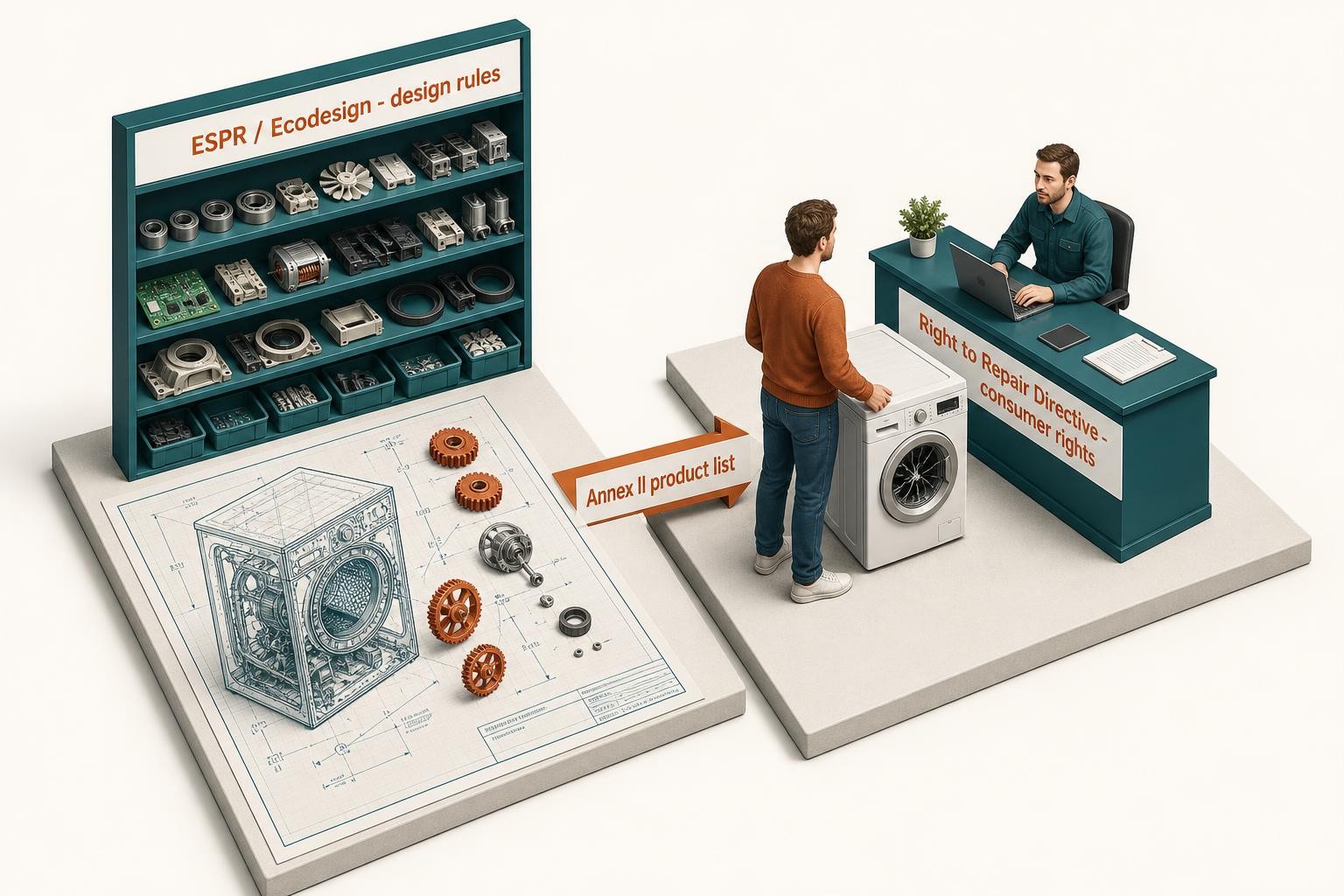
It helps to think of the EU's repair framework as having a supply side and a demand side.
ESPR is the supply side. Regulation (EU) 2024/1781 (ESPR), in force since 18 July 2024, replaced the old Ecodesign Directive and extended ecodesign requirements - including repairability - to nearly all physical products placed on the EU market. Through product-specific delegated acts, ESPR sets the technical rules: minimum spare-parts availability periods, disassembly requirements, repairability scores, and repair-information obligations baked into the product itself. Crucially, ESPR delegated acts are directly applicable regulations - once published in the Official Journal, they apply in all 27 Member States without any national transposition step.
The Right to Repair Directive is the demand side. It does not set product design rules. What it does is create a consumer-enforceable right to use those rules. Manufacturers of products that already carry ESPR or Ecodesign repairability requirements are now legally obliged to actually perform repairs when consumers ask. The Directive is a directive - it must be transposed into national law, which is why the 31 July 2026 date matters and why national implementations (like Germany's draft bill published in January 2026) may add local nuances on top of the baseline.
The Commission's own Q&A confirms that the Annex II product list will be updated annually as new repairability requirements are established for new products, especially within the ESPR framework. Every ESPR delegated act that includes repairability requirements for a new product category automatically feeds into Annex II - and therefore into the repair obligation. The two instruments are structurally coupled.
Who is in scope right now
The products currently covered by Annex II of Directive (EU) 2024/1799 include: household washing machines and washer-dryers, household dishwashers, household refrigerating appliances (fridges, freezers, wine storage), vacuum cleaners, electronic displays including TVs and monitors, mobile phones, cordless phones and tablets, and servers.
A few structural points that compliance teams often miss:
- The obligation reaches back in time. From 31 July 2026, manufacturers must repair in-scope products even if those products were purchased by consumers before that date. A washing machine sold in 2021 is in scope from day one of application.
- Non-EU manufacturers are not exempt. Where a manufacturer is established outside the EU, the obligation passes first to its authorised representative, then to the importer, and then to the distributor. Non-EU brands should audit their economic-operator chain now.
- Repair cannot be refused because someone else repaired it first. Manufacturers cannot refuse to repair a product solely because a previous repair was performed by an independent repairer or by the consumer themselves.
- Scope will grow. As ESPR delegated acts add repairability requirements to new product categories - textiles, furniture, and others are in the 2025-2030 Working Plan - those categories will be added to Annex II. The repair obligation follows automatically.
What the Directive actually requires manufacturers to do
The core obligations sit in Articles 5 and 6. Here is what each one means operationally.
Article 5 - The obligation to repair
Manufacturers must repair in-scope products within a reasonable time and for a reasonable price. The Directive does not prescribe fixed turnaround times or price ceilings - those will be shaped by Member State transposition and market practice - but it is explicit that pricing cannot be set at a level that effectively deters consumers from choosing repair over replacement.
The duration of the repair obligation is determined not by the Directive itself but by the Ecodesign regulation applicable to each product. For household washing machines, Commission Regulation (EU) 2019/2023 requires spare parts such as motors, pumps, and electronic displays to be available for a minimum of 10 years after the last unit is placed on the market. For smartphones, Commission Regulation (EU) 2023/1670 requires spare parts such as batteries, cameras, and speakers to be available for a minimum of 7 years after the last unit is placed on the market. The repair obligation runs for as long as those spare-parts obligations are live.
Manufacturers may sub-contract repairs to third parties but remain legally responsible. They may not use contractual clauses, hardware locks, or software restrictions to impede repair unless justified by legitimate and objective factors (such as IP protection). They also cannot block independent repairers from using original, second-hand, compatible, or 3D-printed spare parts that meet safety requirements.
Article 6 - Information obligations
Manufacturers must make the following available free of charge, in an easily accessible, clear, and comprehensible manner, for the entire duration of their repair obligation:
- Information on the existence and scope of their repair services
- Indicative prices for common repairs, published on a freely accessible website
- Information on spare parts availability and indicative prices for those parts
This is not a one-time publication. The information must remain current and accessible for as long as the repair obligation runs.
The 12-month warranty extension
Where a consumer exercises their statutory warranty rights and chooses repair as the remedy to bring goods into conformity, Directive (EU) 2024/1799 amends Directive (EU) 2019/771 to require the guarantee period to be extended once by one year. The extension applies to the whole product, not just the repaired component. Member States may extend this period further in national transposition.
The ESPR linkage: why this is not a static list
The current Annex II reflects repairability requirements set under the old Ecodesign Directive. As ESPR delegated acts are adopted, the list will grow. The Commission is required to adopt delegated acts to amend Annex II without undue delay after publication of each new Union legal act introducing repairability requirements, and at the latest 12 months after such publication.
The practical implication: if you manufacture furniture, textiles, or other categories currently in the ESPR Working Plan, you are not in scope today - but you should be building the operational infrastructure now. The lead time to set up a repair-request process, publish indicative pricing, and establish spare-parts logistics is measured in months, not weeks.
Compliance checklist for 31 July 2026
Use this as a gap-assessment framework. Each item maps to a specific obligation in the Directive.
List every product model you manufacture or import into the EU. Cross-reference against the current Annex II categories. For each in-scope model, identify the applicable Ecodesign regulation and the spare-parts availability period it mandates. Flag models sold before 31 July 2026 — they are in scope from day one.
If you are a non-EU manufacturer, confirm that your authorised representative in the EU is contractually prepared to perform repair obligations. If you have no authorised representative, your importer carries the obligation. Update distribution and import contracts to reflect this liability allocation before the deadline.
You need a documented, auditable process for receiving, acknowledging, and fulfilling consumer repair requests within a reasonable time. This includes a channel for consumers to submit requests, a workflow for triaging impossibility claims, and a sub-contracting arrangement if you do not perform repairs in-house.
Confirm that spare parts required by the applicable Ecodesign regulation are stocked or contractually available for the full mandated period. Review pricing: parts must be available at a price that does not deter repair. Document your pricing rationale in case of market-surveillance scrutiny.
Article 6 requires a publicly accessible page covering: the existence and scope of your repair obligation, indicative prices for common repairs by product category, and spare-parts availability and indicative prices. This page must be live by 31 July 2026 and kept current for the duration of the obligation.
Review standard terms and conditions, warranty documents, and software update policies for any clause that could be read as restricting independent repair or blocking compatible spare parts. Remove or justify each restriction before the deadline. General terms and conditions that deter repair may be unenforceable under national transpositions.
Customer-facing staff need to understand the new consumer right, the 12-month warranty extension triggered by repair, and the prohibition on refusing repair because a previous repair was done by a third party. Legal teams need to understand how national transpositions (Germany, France, Italy, and others) may add obligations beyond the Directive's baseline.
Set a process to track Commission delegated acts under ESPR. When a new delegated act introduces repairability requirements for a product category you manufacture, you have at most 12 months before that category is added to Annex II — and the repair obligation follows. The ESPR Working Plan 2025–2030 is your forward-looking scope indicator.
The legal form distinction matters for planning
One practical point that often gets lost: the Right to Repair Directive and ESPR delegated acts operate differently in national law.
The Directive must be transposed - each Member State writes it into national legislation, and the precise shape of obligations (penalty levels, enforcement bodies, procedural rules) will vary. Germany's draft bill, for example, introduces the repair obligation directly into the Civil Code and allows consumer protection associations to bring injunction claims against non-compliant manufacturers.
ESPR delegated acts, by contrast, are regulations - they apply directly and uniformly across all 27 Member States the moment they enter into force, with no national transposition required. When a delegated act adds repairability requirements for a new product category, those requirements are immediately binding everywhere in the EU, and the Annex II update follows within 12 months.
The implication for compliance planning: watch the ESPR pipeline as closely as you watch national transposition news. The next expansion of your repair obligation will come from Brussels, not from any single capital.
What "reasonable" will mean in practice
The Directive deliberately avoids prescribing exact turnaround times or price ceilings, leaving interpretation to Member States and courts. What it does make clear is the floor: a manufacturer cannot refuse repair for purely economic reasons, cannot price spare parts at a level that makes repair economically irrational compared to buying new, and cannot use software or hardware to make repair technically impossible without legitimate justification.
Market surveillance authorities across the EU will be watching how manufacturers respond to the first wave of consumer repair requests after 31 July 2026. Building a documented, auditable repair process now - rather than improvising under scrutiny - is the lower-risk path.
The repair obligation applies to products already in consumers' hands before 31 July 2026. A consumer who bought a washing machine in 2022 can request a manufacturer repair from the directive's first day of application. Your spare-parts inventory and repair-request process must be ready for that existing installed base, not just for products sold after the deadline.
The bigger picture
The Right to Repair Directive and ESPR are designed to work as a system. ESPR makes products repairable by design and mandates the spare-parts and information infrastructure. The Directive gives consumers the legal lever to demand that manufacturers actually use that infrastructure. As ESPR delegated acts roll out through 2027 and 2028, the scope of the repair obligation will expand category by category.
For manufacturers, the practical message is straightforward: the operational work required to comply with the Directive - repair-request processes, spare-parts logistics, public pricing pages, trained staff - is not a one-time project. It is a permanent capability that will need to cover more product lines over time. Building it properly before 31 July 2026 is the foundation.
Related reading

What Happens to the Digital Product Passport After the First Sale? ESPR and the Second-Hand Market
ESPR's Digital Product Passport is written around the moment a product is placed on the market. But the passport is meant to last a product's whole life. Here's who carries it into resale, what refurbishers and remanufacturers must actually do, and where the obligations genuinely stop.

Your Ecodesign Implementing Regulation Didn't Lapse on 18 July 2024: The ErP-to-ESPR Migration Map
ESPR repealed Directive 2009/125/EC, but your ErP implementing regulations are still binding. Here's the transition map: what the 2026 and 2030 dates actually close, what migration adds, and what to do now.

SCIP Database and ESPR: Why Your DPP Substance Data Is a Different Beast Entirely
You've been filing SCIP notifications since 2021. ESPR's Digital Product Passport doesn't replace that obligation - it demands something structurally different. Here's what changes and what to do now.