The Green Claims Directive Is Stalled - But EmpCo Binds You on 27 September 2026

There is a date that should be on every product compliance team's calendar: 27 September 2026. Most teams are not tracking it, because they are watching a different file - the Green Claims Directive, which has dominated sustainability-law commentary for two years. That file is, for now, effectively frozen. The rules that actually apply from September are already adopted, already transposed (or being transposed), and already enforceable. They come from a different instrument entirely.
This is not a technicality. It is a planning error that is still being made at scale.
What Actually Happened to the Green Claims Directive
The Green Claims Directive proposal had a clear trajectory until it didn't. The proposal was initially put forward by the Commission in March 2023, seeking to ensure that environmental labels and "green" claims are reliable, comparable, and verifiable across the EU. The Parliament adopted its position at first reading on 12 March 2024, and the Council adopted its position on 17 June 2024. The first trilogue was held on 28 January 2025.
Then the process collapsed. On 20 June 2025, the European Commission announced its intention to withdraw the proposal for a Directive on Green Claims. The trigger was a dispute over scope: the Commission was concerned about the possibility that the directive's scope would be extended to cover approximately 30 million micro-enterprises. Just before the final trilogue negotiations scheduled for 23 June 2025, the Council decided to cancel the meeting with the Parliament in light of the Commission's announcement. On 23 June 2025, Italy officially withdrew its support for the proposal.
Here is the precision that matters for planning: the Commission announced an intention to withdraw - it did not formally withdraw. The Commission has since clarified that the Directive has not been formally withdrawn, but significant uncertainty remains as to the future of the environmental claims law. The European Commission clarified that withdrawal would only be considered if micro-enterprises remained within the scope of the proposal, which the European Parliament had already agreed to exempt. The legislative process is suspended but not formally terminated.
The European Parliament has reaffirmed its willingness to resume the negotiations on the final text of the Directive. The timing and direction of further discussions will depend on the Council's ability to re-establish a common position.
Do not plan around the Green Claims Directive — in either direction. Treating it as dead is wrong (it remains a live proposal). Treating it as imminent is also wrong (trilogues are cancelled with no rescheduled date). The instrument that binds you on 27 September 2026 is EmpCo, not the Green Claims Directive.
What Binds You Instead: EmpCo Mechanics
Directive (EU) 2024/825 - the Empowering Consumers for the Green Transition Directive, universally abbreviated as EmpCo - entered into force on 26 March 2024. It amends Directives 2005/29/EC and 2011/83/EU as regards empowering consumers for the green transition through better protection against unfair practices and through better information. In plain terms: it amends the Unfair Commercial Practices Directive and the Consumer Rights Directive.
Member States had to transpose EmpCo into national law by 27 March 2026. The rules apply to all companies from 27 September 2026. There is no company size exemption, and the rules apply to any company selling to EU consumers, wherever it is headquartered.
EmpCo covers business-to-consumer communication in every channel, including advertising, packaging, product pages, online shops, apps, social media, and the point of sale. Brand names, product names, colours, and symbols count as environmental claims when they suggest a positive environmental impact.
The Two Core Prohibitions
Prohibition 1 - Generic environmental claims. Generic environmental claims such as "ecofriendly", "green", or "responsible" are prohibited unless they are clearly specified and substantiated. The directive defines a generic claim as one that is not clearly and prominently specified on the same marketing medium. Examples include terms like "environmentally friendly," "climate-friendly," "ecological," "eco-safe," or "biodegradable." Directive 2024/825 explicitly prohibits claims of neutral, reduced, or positive environmental impact when they rely on greenhouse gas emission offsetting. A "climate neutral" product label built on purchased carbon credits is, from 27 September 2026, a per-se prohibited commercial practice.
Prohibition 2 - Unsubstantiated sustainability labels. Self-invented labels will be banned. Only labels based on independent certification systems with third-party monitoring or established by public authorities will be permitted. Companies may not develop their own seals or symbols that suggest sustainability without objective, third-party certification criteria. The in-house "green leaf" your marketing team designed in 2019 is not a permissible sustainability label under EmpCo.
Beyond these two headline prohibitions, EmpCo also introduces rules on durability and reparability claims. Businesses can no longer market products as "durable" or "long-lasting" while making repair difficult or impossible. This connects directly to the EU Right to Repair Directive obligations covered in our post on manufacturer obligations under the Right to Repair Directive.
Penalties. Non-compliance can result in fines of up to 4% of annual turnover in the relevant member state.
Three Claims a Manufacturer Might Make - and Which Are Now Unsafe
The following examples are illustrative of the risk categories, not legal advice. Each should be assessed against your specific facts and the national transposition in the relevant member state.
| Claim as typically used | Claim type | EmpCo risk from 27 Sep 2026 | What a defensible version looks like |
|---|---|---|---|
| "Our product is eco-friendly" (on packaging, no further detail) | Generic environmental claim | HIGH — per-se prohibited unless clearly specified on the same medium | Replace with a specific, scoped claim: e.g. "Made with 40% post-consumer recycled content (verified by [named scheme])" with the evidence accessible at point of sale |
| "Carbon neutral product" (based on offset credits) | Offset-based neutrality claim | HIGH — explicitly prohibited where the claim rests on offsetting outside the value chain | Disclose actual measured lifecycle emissions; if offsets are used, they cannot be the basis of a neutrality claim — state residual emissions and the verified reduction trajectory instead |
| Company-designed "Sustainability Certified" badge (no external scheme) | Self-declared sustainability label | HIGH — self-invented labels are prohibited; only labels from independent certification schemes or public authorities are permitted | Migrate to a recognised third-party certification scheme with public, transparent rules and independent monitoring, or remove the label |
Why Your ESPR Programme Is Your Claims Defence
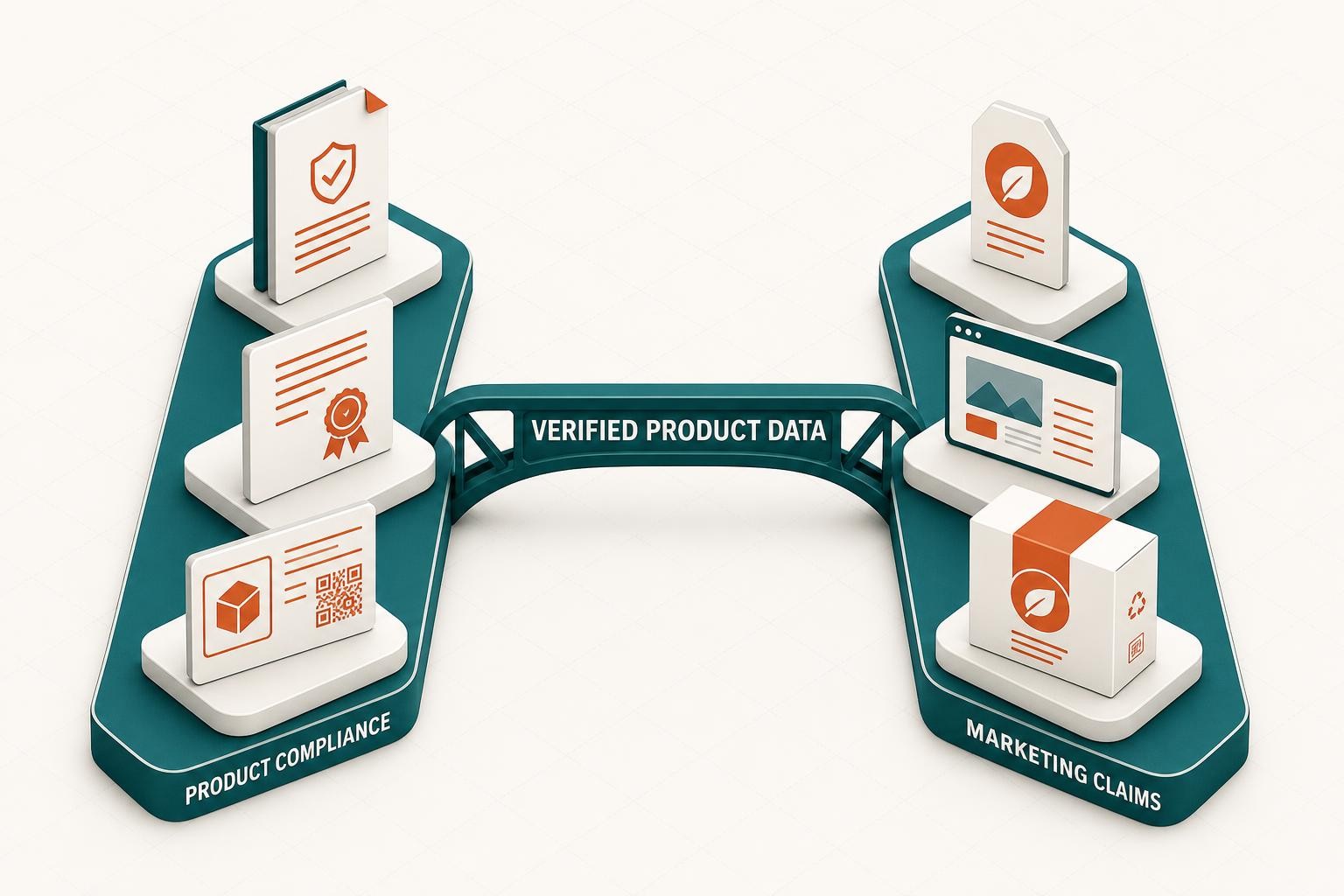
Here is the structural argument that most compliance teams are missing: the ESPR workstream and the marketing claims workstream are not separate problems. They are the same problem, approached from different ends.
The Ecodesign for Sustainable Products Regulation (ESPR) sets requirements for how products are designed and how their environmental performance must be documented. The EmpCo Directive governs how that performance is communicated to consumers. The two regulations are complementary: what ESPR requires companies to measure and prove, EmpCo requires them to communicate accurately.
The connection runs through the Digital Product Passport. EmpCo and the DPP are two sides of the same coin: EmpCo requires a green claim to be provable; the DPP is precisely the tool that makes the supporting data available in a structured, trustworthy and verifiable form. A DPP field populated through a conformity assessment - recycled content percentage, repairability score, carbon footprint per functional unit - is categorically stronger evidence than a marketing team's internal spreadsheet. It is structured, machine-readable, anchored to a technical file, and auditable by market surveillance authorities.
EmpCo works alongside other regulatory initiatives such as the Digital Product Passport (under the ESPR) and the Packaging and Packaging Waste Regulation (PPWR), which require increasingly detailed, verifiable product information. The data architecture you are building for ESPR compliance is, simultaneously, the evidentiary infrastructure for EmpCo-compliant claims.
There is a further interaction to watch. ESPR delegated acts will eventually mandate specific performance-class labelling for some product groups - energy efficiency classes being the established model. Where a delegated act mandates a label, that label will be established by a public authority and will therefore satisfy EmpCo's sustainability label requirement automatically. The implication: for product groups where delegated acts are advancing, the ESPR label will become the compliant claim vehicle. For product groups where delegated acts are not yet in force, you need a third-party certification scheme or a precisely specified, evidence-backed claim. Our post on what goes into a Digital Product Passport explains the data fields and access architecture in detail.
The Honest Gap: No Harmonised Substantiation Methodology
EmpCo is binding. But it does not itself specify how to substantiate a claim - it specifies that claims must be substantiated, and that generic ones are prohibited. EmpCo sets the broad framework (what may no longer be said and what information must be disclosed), while the Green Claims Directive was intended to delve deep into the how of substantiation.
That gap is real and consequential. Instead of one set of substantiation rules, companies face EmpCo's broad prohibitions layered on top of national enforcement under the existing Unfair Commercial Practices Directive. Businesses should monitor national transposition measures, enforcement guidance, and case law as Member States implement EmpCo. Many Member States missed the transposition deadline. As of June 2026, Germany (via the UWG) and Italy (via the Consumer Code), among others, have fully transposed the directive into national law.
The practical consequence: a claim that passes muster under a German court's interpretation of the UWG may face a different standard in a Member State that has not yet transposed or has transposed differently. For manufacturers selling across multiple EU markets, this creates a compliance floor problem - you need to be defensible in the strictest jurisdiction, not the most permissive one.
What a defensible internal standard looks like in the interim:
- Claim inventory first. Map every consumer-facing environmental claim across all channels - packaging, product pages, advertising, social media, point-of-sale materials. Brand names, product names, colours, and symbols count as environmental claims when they suggest a positive environmental impact - the scope is wider than most teams assume.
- Pair each claim to an evidence source. Create an evidence folder for each permissible claim: certificates, methodological documentation, measurement data, independent expert opinions. This collection is your defence line in any dispute.
- Apply the "same medium" test. A generic term is only permissible if it is clearly and prominently specified on the same marketing medium. If the substantiation is buried in a footnote on a separate webpage, the claim on the packaging is still generic.
- Retire offset-based neutrality claims now. Offset-based climate neutrality claims disappear entirely under EmpCo. There is no grace period and no transitional arrangement.
- Audit your labels. Any sustainability label that is not based on a recognised certification scheme with public, transparent rules and independent monitoring must be removed or replaced before 27 September 2026.
Dated Action List: Before 27 September 2026
The 27 September 2026 date is fixed. From that date, companies must ensure that their commercial practices, including green claims and use of sustainability labels, comply with the requirements introduced by the new rules - including for products already on the market. There is no phase-in for existing product lines.
The Green Claims Directive may yet return in some form. If the Green Claims Directive were to come as planned, it would complement EmpCo by establishing an EU-wide uniform verification system for the specific green claims that are still permitted. But waiting for it is not a compliance strategy. The instrument that matters for September is already law.
This post is for informational purposes only and does not constitute legal advice. EmpCo is transposed through national law; the applicable rules in any given EU member state depend on that state's implementing legislation. Consult qualified legal counsel for advice specific to your products and markets.
Related reading

What Happens to the Digital Product Passport After the First Sale? ESPR and the Second-Hand Market
ESPR's Digital Product Passport is written around the moment a product is placed on the market. But the passport is meant to last a product's whole life. Here's who carries it into resale, what refurbishers and remanufacturers must actually do, and where the obligations genuinely stop.

Your Ecodesign Implementing Regulation Didn't Lapse on 18 July 2024: The ErP-to-ESPR Migration Map
ESPR repealed Directive 2009/125/EC, but your ErP implementing regulations are still binding. Here's the transition map: what the 2026 and 2030 dates actually close, what migration adds, and what to do now.

SCIP Database and ESPR: Why Your DPP Substance Data Is a Different Beast Entirely
You've been filing SCIP notifications since 2021. ESPR's Digital Product Passport doesn't replace that obligation - it demands something structurally different. Here's what changes and what to do now.