The EU Battery Passport: The First Hard DPP Deadline - and What It Signals for Every Other Product
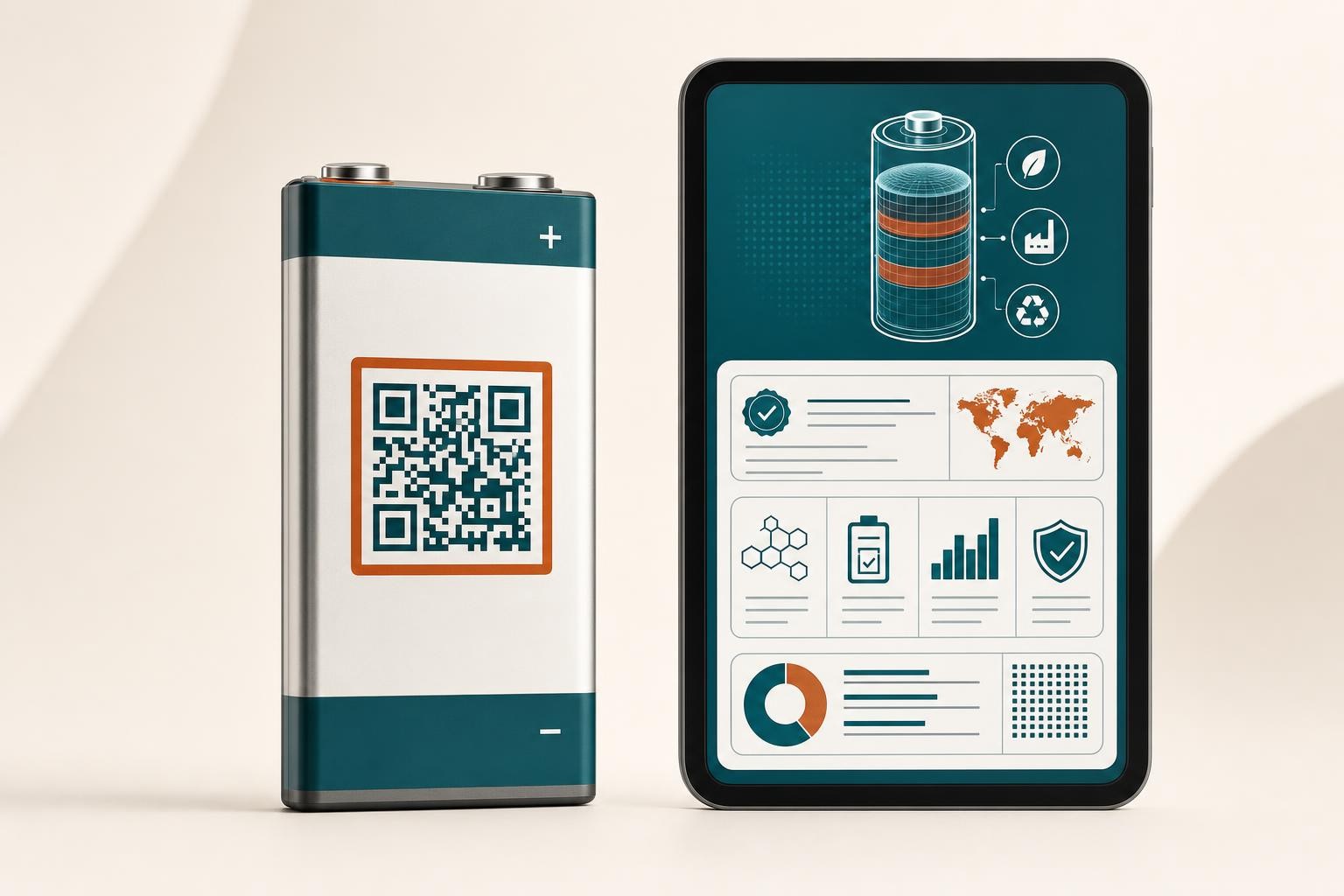
The EU has been talking about Digital Product Passports for years. On 18 February 2027, the talking stops - at least for one product category. The battery passport is the first DPP with a fixed, legislated deadline, and it is already live enough to block products at EU customs if you miss it. Every other sector watching the ESPR DPP rollout should be watching this deadline just as closely.
What the battery passport actually is
The battery passport is mandated by Article 77 of Regulation (EU) 2023/1542 - the EU Battery Regulation - which entered into force on 17 August 2023. It is not a label, a PDF, or a declaration of conformity. It is a structured, machine-readable electronic record linked to the physical battery via a QR code, and it must remain accurate and accessible throughout the battery's entire service life.
The QR code resolves to a Unique Battery Identifier that links all passport data to a specific battery model or serial number, enabling traceability across manufacturing, ownership changes, repurposing, and end-of-life treatment. The data behind that identifier is not a single flat file - it is tiered by access role.
Three tiers of access
The regulation does not demand total transparency; it demands tiered transparency. The passport framework is organised into three distinct information layers:
- Public layer - accessible to any consumer who scans the QR code: basic identification, battery category, carbon footprint performance class, recycled content percentages, rated capacity, expected service life, and end-of-life guidance.
- Restricted layer - accessible to persons with a legitimate interest (independent repairers, second-life operators, recyclers): detailed chemistry, dismantling procedures, state-of-health parameters, and advanced safety protocols.
- Authority layer - reserved for market surveillance authorities and the European Commission: full supply chain due diligence records and enforcement-relevant data.
This role-based access control is designed to protect commercially sensitive IP while still feeding the circular economy with the data it needs.
What data must the passport carry?
Annex XIII of the regulation defines the mandatory fields. They fall into four groups:
Annex XIII requires: (1) identity and origin - manufacturer name, manufacturing location, manufacturing date, battery model, GTIN, and passport number; (2) performance - rated capacity, voltage, energy density, cycle life, and expected lifetime; (3) sustainability - carbon footprint in kg CO₂e per kWh, recycled content percentages for cobalt, lithium, nickel, and lead, and supply chain due diligence declarations; (4) supply chain - the economic operators involved, including raw material suppliers, cell manufacturers, and recyclers.
State-of-health (SoH) data - a measure of remaining capacity and power capability relative to original specifications - is a key data point for EV and industrial batteries, enabling second-life operators to make informed purchasing decisions without costly independent testing.
Who is in scope from 18 February 2027?
From 18 February 2027, EV batteries, LMT batteries (e-bikes, e-scooters), and industrial batteries with a capacity above 2 kWh placed on the EU market must each carry a battery passport accessible via QR code, under Article 77(1) of Regulation (EU) 2023/1542. Portable batteries and SLI (starter, lighting, ignition) batteries are outside the full passport scope, though they still require a QR code linking to a declaration of conformity.
The obligation falls on the economic operator placing the battery on the EU market - not necessarily the physical manufacturer. For importers, this means batteries manufactured before February 2027 but imported into the EU after that date must still comply. Non-EU suppliers who cannot provide the required data in machine-readable format become a market-access problem, not just a procurement inconvenience.
Non-compliant batteries may be refused entry at EU borders, removed from the market, or subject to financial penalties set by individual Member States, which must be effective and dissuasive under Article 93 of the regulation.
Importers: the deadline applies at the point of EU market placement, not at the point of manufacture. A battery made in January 2027 and shipped to an EU distributor in March 2027 must have a compliant passport. Audit your non-EU suppliers' data readiness now — not after the first shipment is blocked.
Why this matters beyond batteries: the ESPR DPP blueprint
The battery passport and the ESPR Digital Product Passport are legally separate instruments - the Battery Regulation predates ESPR and has its own governing text. But they are architecturally the same thing, and that is the point.
The battery passport uses GS1 Digital Link standards, QR code access, and a three-tier data model (public, restricted, authority) that all future DPPs under ESPR will replicate. The infrastructure is identical: GS1 Digital Link URIs for product identification, QR codes conforming to ISO/IEC 18004 as data carriers, JSON-LD structured data formats, and the same role-based access model. The differences between product categories will be in the data fields, not the underlying architecture.
The EU Central DPP Registry is scheduled to go live on 19 July 2026, with battery manufacturers beginning to upload product data in preparation for the February 2027 mandate - effectively serving as the DPP system's live beta test.
The ESPR Working Plan 2025-2030, adopted on 16 April 2025, confirms the phased rollout that follows:
| Product Category | Governing Instrument | Delegated Act Status | Compliance Deadline | Date Type |
|---|---|---|---|---|
| EV, LMT & industrial batteries (>2 kWh) | Regulation (EU) 2023/1542 | In force | 18 February 2027 | ✅ Fixed in law |
| Iron & steel | ESPR delegated act | Adoption expected 2026 | ~18 months after adoption | ⚠️ Indicative |
| Textiles & apparel | ESPR delegated act | Expected Q2 2027 | ~late 2028 / early 2029 | ⚠️ Indicative |
| Furniture | ESPR delegated act | Expected 2028 | ~2029/2030 | ⚠️ Indicative |
| Electronics & ICT | ESPR delegated act | Expected 2028–2029 | ~2030+ | ⚠️ Indicative |
The critical distinction: only the battery passport deadline is fixed in primary legislation. Every other DPP date in the table above is indicative - it depends on when the Commission adopts the relevant delegated act. Published ESPR timelines have already shown a consistent pattern of 6-12 months of slippage. That does not mean other sectors can relax; it means they should use the battery passport implementation as a live case study while their own clock is still running slowly.
What to do now
The practical steps differ depending on your role and timeline.
If you place in-scope batteries on the EU market:
The window is shorter than it looks. Projects of this scope - carbon footprint calculation methodologies, notified body verification, supplier data contracts, registry infrastructure - rarely complete in under 18 months from initial scoping. With the EU DPP Registry going live in July 2026, you need to be in test mode before that date, not starting your gap analysis.
If you are in a non-battery sector watching ESPR:
The battery passport is your proof-of-concept. The data architecture, enforcement model, and compliance patterns will carry over directly to your own DPP obligations. A manufacturer who builds battery passport capability now is building infrastructure applicable to future DPP obligations across their product range.
The bottom line
The battery passport is not a pilot programme or a voluntary scheme. From 18 February 2027, batteries placed on the EU market without a registered Digital Product Passport cannot legally be sold in the EU - market surveillance authorities will enforce from day one. For manufacturers and importers in scope, the compliance clock is already running. For everyone else in the ESPR pipeline, the battery passport is the clearest signal yet of what the Commission's DPP architecture looks like in practice - and how seriously it intends to enforce it.
The 18 February 2027 deadline is fixed. The question is whether your data infrastructure will be ready when it arrives.
Last reviewed: June 2026. The due diligence obligations under Article 48 were postponed to 18 August 2027 via Regulation (EU) 2025/1561; the battery passport deadline itself has not changed.
Related reading

What Happens to the Digital Product Passport After the First Sale? ESPR and the Second-Hand Market
ESPR's Digital Product Passport is written around the moment a product is placed on the market. But the passport is meant to last a product's whole life. Here's who carries it into resale, what refurbishers and remanufacturers must actually do, and where the obligations genuinely stop.

Your Ecodesign Implementing Regulation Didn't Lapse on 18 July 2024: The ErP-to-ESPR Migration Map
ESPR repealed Directive 2009/125/EC, but your ErP implementing regulations are still binding. Here's the transition map: what the 2026 and 2030 dates actually close, what migration adds, and what to do now.

SCIP Database and ESPR: Why Your DPP Substance Data Is a Different Beast Entirely
You've been filing SCIP notifications since 2021. ESPR's Digital Product Passport doesn't replace that obligation - it demands something structurally different. Here's what changes and what to do now.