ESPR and Mandatory Green Public Procurement: What Article 65 Means for Buyers and Suppliers

Most coverage of the Ecodesign for Sustainable Products Regulation focuses on what manufacturers must build into their products. Far less attention has gone to a separate, equally consequential mechanism buried in the same text: the power to make green public procurement legally mandatory across the EU. That power sits in Article 65 of Regulation (EU) 2024/1781, and it will reshape how public money is spent on physical goods.
This post explains the Article 65 mechanism precisely - what is already fixed in the Regulation, what still depends on future acts, and what both contracting authorities and their suppliers should be doing right now.
Why public procurement is the right lever
Public procurement represents around 14% of EU GDP - roughly €2 trillion a year flowing through more than 250,000 contracting authorities across the Member States. When governments buy furniture for public buildings, uniforms for civil servants, or steel for infrastructure, they are collectively one of the largest single buyers on the continent.
That scale is precisely why the Commission chose to embed a procurement mechanism inside ESPR. Voluntary green public procurement (GPP) criteria have existed for years, but uptake has been patchy and uneven across Member States. Fewer than 15% of large EU public contracts are currently green, despite the Commission's long-standing guidance. Article 65 changes the legal character of GPP from a best-practice recommendation to a binding obligation - for specific product groups, once the relevant implementing act is in force.
Voluntary vs. mandatory GPP — the key distinction. Today's EU GPP criteria (published by the Commission's Joint Research Centre) are guidance documents. Contracting authorities may use them; they are not required to. Article 65 of ESPR creates a separate legal track: once the Commission adopts a product-specific implementing act under Article 65, compliance becomes mandatory for all contracting authorities and contracting entities covered by that act. The two systems coexist — but only the Article 65 route carries legal force.
What Article 65 actually empowers the Commission to do
Article 65 authorises the Commission to adopt implementing acts that set minimum mandatory GPP requirements for the product groups regulated under ESPR. Three things are worth noting about the legal architecture:
Implementing acts, not delegated acts. The ecodesign performance and information requirements for a product group are set by a delegated act. The GPP requirements for the same group are set by a separate implementing act. These are distinct legal instruments, but the Commission has confirmed it will evaluate and adopt them in parallel wherever feasible.
Tied to the same product groups. GPP implementing acts can only address product groups already covered by an ESPR ecodesign delegated act. There is no standalone GPP track - the procurement rules follow the ecodesign rules.
Conditioned on feasibility. The Commission must consider the value and volume of public contracts for the relevant product group, and the economic feasibility for contracting authorities to buy the most environmentally sustainable options. Not every ESPR-regulated product will automatically receive a GPP implementing act.
The three forms a GPP requirement can take
Once an implementing act is in force, it can impose requirements in any of the following forms - or a combination:
| Requirement type | What it means in a tender |
|---|---|
| Technical specification | Products must meet the top two performance classes or scores for the relevant ecodesign criteria (e.g. carbon footprint class A or B). Non-compliant products cannot be offered. |
| Award criterion | Environmental sustainability factors must be weighted at 15-30% of the evaluation score. Buyers cannot ignore sustainability in the scoring. |
| Contract performance condition / target | A minimum share of the contract - for example, that at least 50% of annual procurement for a product category meets a specified standard (such as containing more than 70% recyclable material). |
The minimum-share mechanism
The minimum-share provision is the most structurally novel element. An implementing act may mandate that, every year or over several years, at least 50% of procurement by contracting authorities or entities - or at a national level in total - must involve the most environmentally sustainable products specified in the related delegated act. Member States retain the right to set stricter national targets if they choose.
This is not a target that contracting authorities can choose to miss with a written justification. Once an implementing act sets a minimum share, hitting that share is a legal obligation.
Which product groups are in scope first?
The first ESPR and Energy Labelling Working Plan (COM(2025) 187), adopted on 16 April 2025, prioritises textiles (especially apparel), furniture, mattresses, tyres, iron & steel, and aluminium, plus horizontal measures on repairability and recycled content. These are the product groups for which ecodesign delegated acts will be developed first - and therefore the groups for which GPP implementing acts will be assessed in parallel.
Indicative timelines for delegated acts (all provisional): iron & steel around 2026; textiles, tyres, and aluminium around 2027; furniture and mattresses later in the 2025-2030 window. GPP implementing acts would follow on a similar schedule, subject to the Commission's feasibility assessment for each group.
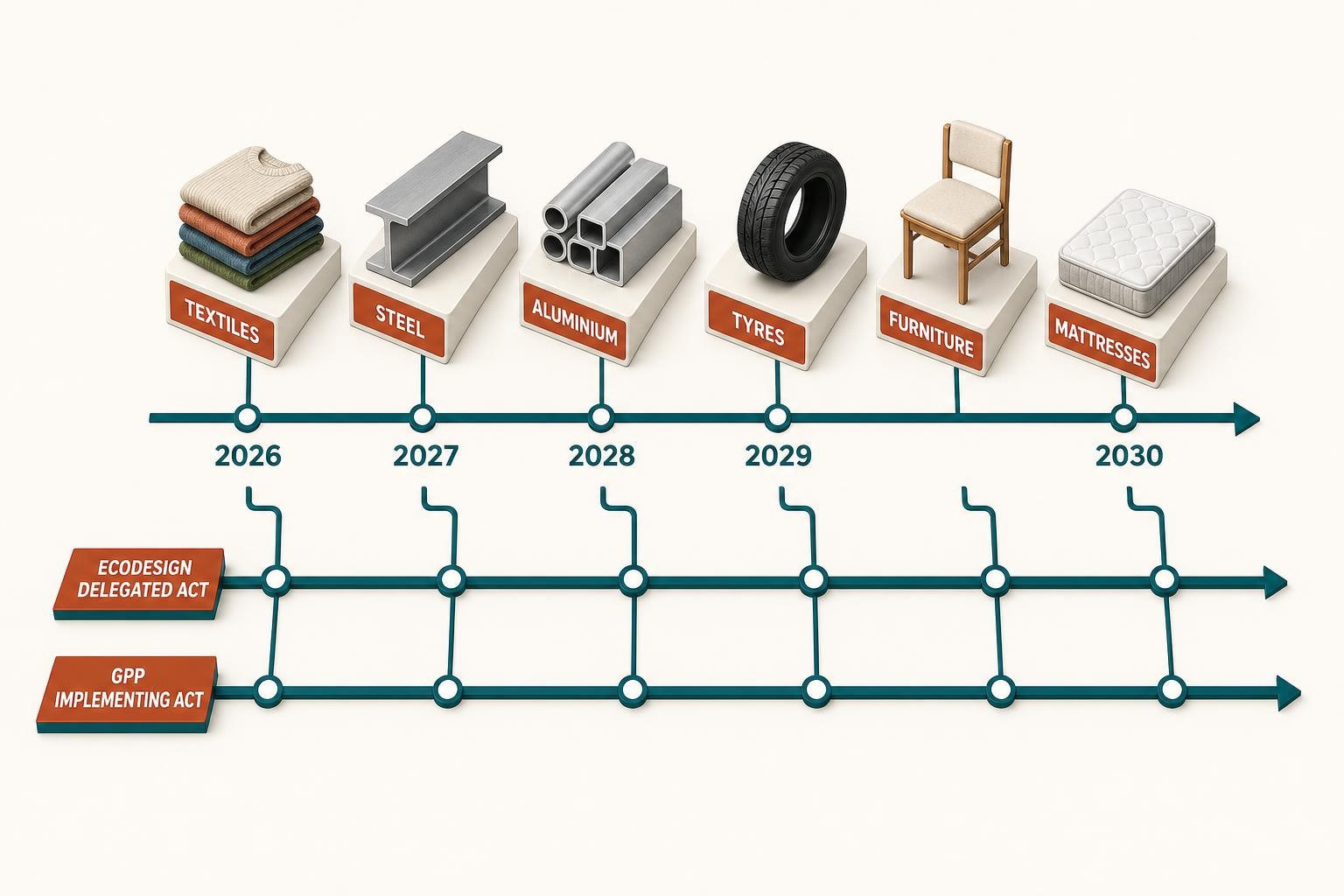
From delegated act to tender document: a worked example
Suppose the Commission adopts a delegated act for office furniture that defines a repairability score and a recycled-content class. The accompanying GPP implementing act might then specify:
- Technical specification: Only furniture achieving repairability score ≥ 7/10 and recycled-content class A or B may be offered in response to public tenders.
- Award criterion: Environmental performance (recycled content, durability, end-of-life recyclability) must account for at least 20% of the evaluation score.
- Procurement target: At least 50% of an authority's annual furniture spend must go to products meeting the above specification.
A contracting authority running a framework agreement for office furniture would need to write these requirements into its technical specifications and evaluation methodology - not as optional sustainability clauses, but as mandatory conditions. Suppliers that cannot demonstrate compliance with the delegated act's performance classes would be ineligible to bid.
What suppliers should be documenting now
The product-specific thresholds do not yet exist - they will be set by delegated acts that are still being drafted. But the parameters those acts will draw on are already defined in ESPR's Annex I. Suppliers in the priority product groups should start building evidence files around:
- Durability: Tested service life, warranty terms, availability of spare parts and repair instructions.
- Recycled content: Verified percentage by weight of recycled input materials, with supply-chain documentation.
- Repairability: Disassembly scores, access to repair manuals, spare-part availability windows.
- Recyclability: Material composition by fraction, design-for-disassembly assessments.
- Digital Product Passport data: The DPP will be the primary vehicle for communicating this information to contracting authorities and verification bodies. Suppliers who cannot populate DPP fields will struggle to prove compliance in a tender.
Manufacturers selling into public-sector channels will need to meet ESPR performance thresholds to remain eligible for procurement contracts, creating direct commercial pressure to invest in sustainability performance well before implementing acts are formally adopted.
How this differs from today's voluntary GPP
The table below summarises the structural differences between the existing voluntary GPP framework and the mandatory Article 65 mechanism.
| Dimension | Voluntary EU GPP Criteria (today) | Mandatory ESPR GPP (Article 65) |
|---|---|---|
| Legal basis | Commission guidance documents (JRC) | Implementing acts under Regulation (EU) 2024/1781 |
| Obligation on buyers | None — use at discretion | Binding once implementing act is in force |
| Product scope | Selected groups with JRC criteria | ESPR-regulated groups only; assessed per group |
| Performance level | Core or comprehensive criteria (buyer's choice) | Top two performance classes from delegated act |
| Minimum share | No | Yes — up to 50% of annual procurement |
| Award criteria weighting | Recommended, not mandated | 15–30% mandatory weighting |
| Member State flexibility | Full discretion | Can set stricter targets; cannot set weaker ones |
The compliance clock for contracting authorities
Contracting authorities do not need to act today on Article 65 - no implementing act has yet been adopted for any ESPR product group. But the lead time for updating procurement frameworks, framework agreements, and internal guidance is typically 12-24 months. Authorities that wait for implementing acts to be published before starting their internal review will be under significant time pressure.
Practical steps to take now:
- Map your product spend against the ESPR Working Plan priority groups. Identify which of your framework agreements cover textiles, furniture, steel, aluminium, tyres, or mattresses.
- Review your standard technical specifications and award criteria templates for those categories. Flag where sustainability criteria are currently absent or purely voluntary.
- Engage your legal and procurement teams on the distinction between the existing voluntary GPP criteria and the forthcoming mandatory Article 65 requirements - they are not the same instrument.
- Monitor the Commission's delegated act pipeline. GPP implementing acts will be assessed and adopted alongside the ecodesign delegated acts. The Working Plan's indicative timelines are your earliest signal.
What is fixed and what is still to come
To be precise about the regulatory state of play:
Fixed in Regulation (EU) 2024/1781:
- The legal power to adopt mandatory GPP implementing acts (Article 65)
- The three forms requirements can take (technical specifications, award criteria, contract performance conditions/targets)
- The minimum-share mechanism (up to 50% of annual procurement)
- The mandatory award-criteria weighting range (15-30%)
- The requirement that technical specifications target the top two performance classes
- The product groups that must be considered for the Working Plan (Article 18(3))
Still to be determined by future acts:
- Which specific product groups will receive a GPP implementing act (not all ESPR-regulated groups will)
- The exact performance thresholds and class definitions (set by each delegated act)
- The specific minimum share percentages and timelines (set by each implementing act)
- Whether requirements apply at organisation level, national level, or both
The framework is in place. The product-specific rules are coming. For public-sector buyers and their suppliers, the question is not whether mandatory green procurement will arrive - it is whether they will be ready when it does.
Related reading

What Happens to the Digital Product Passport After the First Sale? ESPR and the Second-Hand Market
ESPR's Digital Product Passport is written around the moment a product is placed on the market. But the passport is meant to last a product's whole life. Here's who carries it into resale, what refurbishers and remanufacturers must actually do, and where the obligations genuinely stop.

Your Ecodesign Implementing Regulation Didn't Lapse on 18 July 2024: The ErP-to-ESPR Migration Map
ESPR repealed Directive 2009/125/EC, but your ErP implementing regulations are still binding. Here's the transition map: what the 2026 and 2030 dates actually close, what migration adds, and what to do now.

SCIP Database and ESPR: Why Your DPP Substance Data Is a Different Beast Entirely
You've been filing SCIP notifications since 2021. ESPR's Digital Product Passport doesn't replace that obligation - it demands something structurally different. Here's what changes and what to do now.