The EU Battery Passport: What the Data Must Actually Say - and Why Every ESPR Product Team Should Be Watching
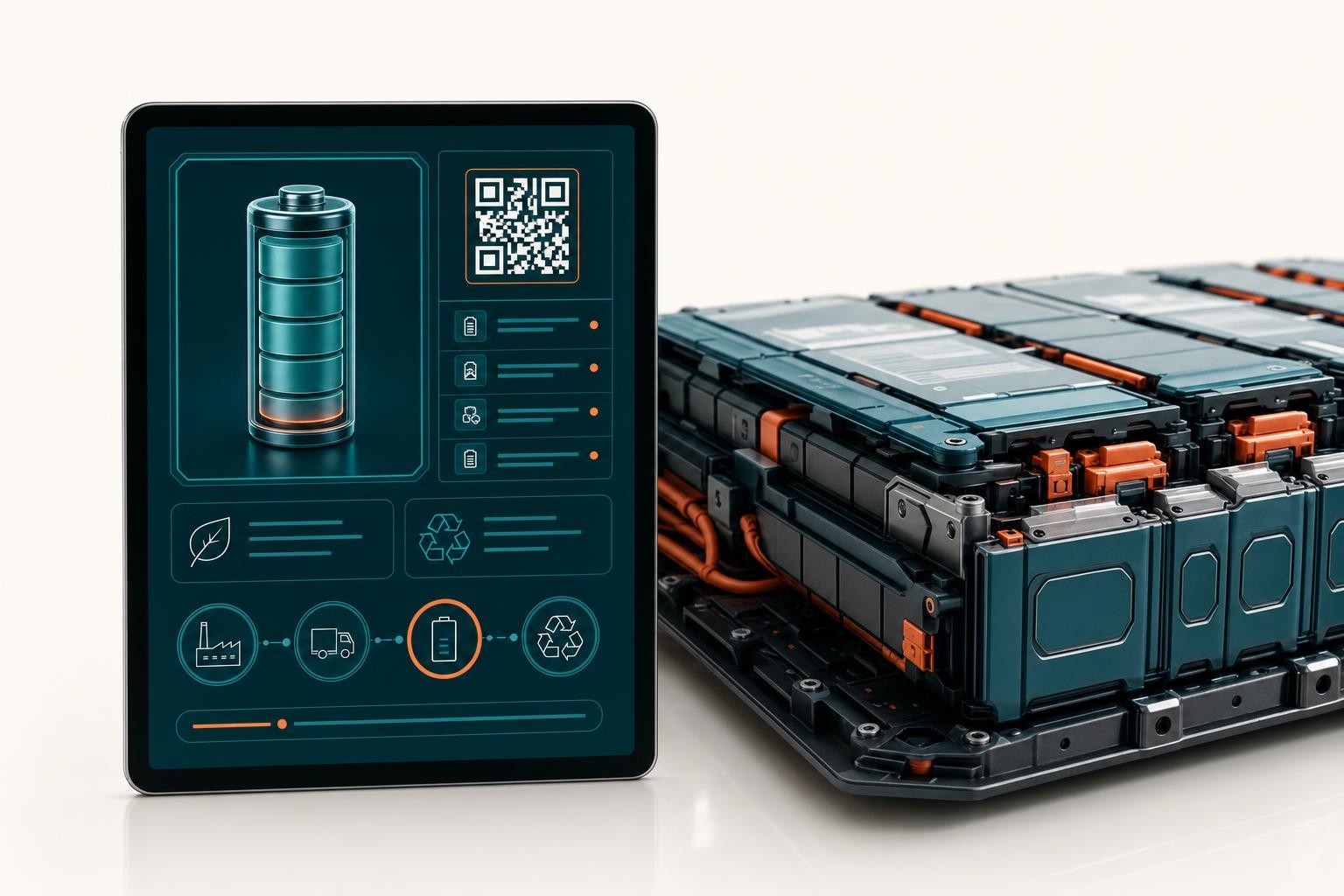
The EU battery passport is not the most talked-about regulation in Brussels right now. It is, however, the one with the hardest near-term deadline and the widest downstream consequences. From 18 February 2027, every EV battery, light means of transport (LMT) battery, and industrial battery with a capacity above 2 kWh placed on the EU market must carry a digital battery passport under Article 77 of Regulation (EU) 2023/1542. Miss that date, and the battery cannot legally be sold in the EU - full stop.
What makes this regulation worth studying beyond the battery sector is its structural role. The battery passport is the first mandatory Digital Product Passport anywhere in the world, and the technical architecture it establishes - unique identifiers, tiered data access, machine-readable formats, live registry linkage - is the same architecture that will underpin DPPs for textiles, electronics, furniture, and every other product category in the ESPR Working Plan 2025-2030. How it performs in practice will shape the enforcement model and data requirements that follow for years.
Who is actually in scope
The passport requirement targets three battery categories placed or put into service on the EU market:
- EV batteries - traction batteries in electric vehicles
- LMT batteries - batteries in e-bikes, e-scooters, and other light means of transport
- Industrial batteries above 2 kWh - including stationary energy storage systems
Portable consumer batteries and SLI (starter, lighting, ignition) batteries are not subject to the passport requirement for now, though other parts of the regulation - including labelling and QR code obligations - still apply to them.
Each passport is unique to an individual battery, not to a model. A production run of 10,000 packs means 10,000 passports. The economic operator placing the battery on the EU market is responsible for creating the passport and keeping it accurate throughout the battery's service life.
What the passport must actually contain
This is where most compliance teams underestimate the task. The regulation is not asking for a product datasheet or a PDF declaration. For EV batteries, Article 77 and Annex XIII of Regulation (EU) 2023/1542 set out around 80 mandatory data attributes spanning the entire lifecycle. The Battery Pass Consortium groups these into seven content clusters:
| Data Cluster | Key Data Points | Static or Dynamic? |
|---|---|---|
| General battery & manufacturer information | Model ID, batch/serial numbers, manufacturing date and location, manufacturer name and address | Static |
| Compliance & labels | CE marking, Declaration of Conformity, hazardous substance disclosures, SVHC above 0.1% | Static |
| Carbon footprint | Lifecycle carbon footprint per kWh, carbon footprint performance class | Static at manufacture; updated if methodology changes |
| Supply chain due diligence | Responsible sourcing of cobalt, lithium, nickel, natural graphite; third-party verification status | Static at manufacture |
| Materials & composition | Chemical composition, hazardous substances, recycled content percentages | Static |
| Circularity & resource efficiency | Recycled content declarations, design-for-disassembly information, end-of-life handling instructions | Static |
| Performance & durability | Rated capacity, state of health (SoH), expected lifetime, cycle life, temperature range | Dynamic — updated via BMS data feed |
The performance and durability cluster is the most technically demanding. The battery passport must be a living document, updated throughout the product's service life - not a one-time declaration. This is the precedent that matters most for ESPR: the infrastructure for ongoing data updates, not just point-in-time disclosures, is being established here first.
Tiered access: not everything is public
The regulation does not demand total transparency. It demands tiered transparency. The QR code resolves to a Unique Battery Identifier, and what a user can see depends on who they are:
- General public - safety, sustainability, and basic identification data (a "nutrition label" layer)
- Recyclers, repairers, second-life operators - detailed composition, disassembly instructions, state of health
- Market surveillance authorities and customs - full dataset including supply chain due diligence records
Commercially sensitive information - IP-protected manufacturing processes, precise supplier identities - can be protected behind the restricted layers. This three-tier model is being carried directly into the ESPR DPP architecture.
The August 2026 labelling step you cannot skip
Before the full passport mandate arrives, a practical first deadline lands in weeks. From 18 August 2026, significantly more comprehensive physical labelling requirements apply under Article 13 of Regulation (EU) 2023/1542, including mandatory disclosure of capacity, expected lifespan, chemical composition, correct disposal instructions, and classification into carbon footprint performance classes.
This is not a minor label update. Batteries must carry the general information set out in Part A of Annex VI - or, where the battery surface is too small, that information must appear on the packaging or accompanying documentation. Carbon footprint performance class labelling for EV batteries also kicks in from this date.
The August 2026 labelling step matters operationally because it forces manufacturers to have their carbon footprint data structured and verified before the passport deadline. Teams that treat labelling and passport as separate workstreams will find themselves doing the same data-gathering exercise twice.
The due diligence delay does NOT move the passport deadline. Regulation (EU) 2025/1561 — part of the Omnibus IV package — postponed battery supply-chain due diligence obligations by two years, from 18 August 2025 to 18 August 2027. The battery passport deadline of 18 February 2027 is unchanged. Companies that read the due diligence delay as a general reprieve are misreading the regulation.
The readiness gap is real
According to the KPMG European Digital Product Passport Readiness Survey (February 2026), which covered more than 70 organisations across 13 European countries, 81% of affected companies still have no implementation plan. That figure is striking given that the survey was published less than 12 months before the passport deadline, and that industry analysts consistently estimate 12-18 months as the minimum implementation timeline for the necessary data infrastructure.
The root causes are familiar: fragmented ERP and PLM systems that were never designed to capture lifecycle data at the battery level, supplier hesitancy around data sharing and confidentiality, and a widespread assumption that the regulation will be delayed the way due diligence was. That last assumption is the most dangerous one.
Why this is the proof-of-concept for everything that follows
The battery passport is not an isolated compliance exercise. The technical infrastructure it deploys - GS1 Digital Link URIs for product identification, QR codes conforming to ISO/IEC 18004, JSON-LD structured data formats, and the three-tier access model - is the same architecture that ESPR delegated acts for textiles, electronics, and furniture will build on. The differences between product categories will be in the data fields, not the underlying architecture.
The European Commission's Joint Research Centre is developing the technical standards for this data exchange, and those standards will inform the broader ESPR data architecture. Manufacturers with product portfolios spanning batteries and other ESPR-covered categories - industrial equipment, electronics, components - who build DPP capability now are not just solving a battery compliance problem. They are building the infrastructure they will need again, at scale, for every subsequent delegated act.
What to do before February 2027
The compliance path is sequential, not parallel. Teams that try to build the passport before they have clean, structured data at the unit level will rebuild it. The logical order:
- Scope your portfolio - confirm which battery categories you place on the EU market and whether the 2 kWh threshold applies to your industrial products.
- Audit your data - map every required Annex XIII data attribute against where it currently lives (or doesn't) in your systems.
- Fix the August 2026 labelling gap first - carbon footprint data and performance class classification must be ready before the passport can be complete.
- Engage suppliers now - Annex XIII requires composition and sourcing data that most tier-2 and tier-3 suppliers are not currently structured to provide.
- Select passport infrastructure - the system must produce machine-readable, interoperable output linked to a Unique Battery Identifier; a QR code pointing to a marketing page does not meet Article 77(6).
- Build for updates - state of health and performance data must be updatable throughout the battery's life, not locked at manufacture.
The February 2027 deadline is fixed. The August 2026 labelling step is already here. And the 81% of companies with no implementation plan are running out of runway faster than the calendar suggests.
Related reading

ESPR Performance Classes: The Ranking System That Makes Compliance Irrelevant to Competitiveness
ESPR's classes of performance rank compliant products against each other. A product can be fully lawful and still be publicly graded near the bottom of its category. Here's what that means for your product roadmap.
Who Sees What in a Digital Product Passport: Access Rights, Customs and Confidential Business Data
A passport is not a public web page. ESPR gives consumers, repairers, recyclers, authorities and customs different views of the data. Here is how role-based access works, what the pending security standards add, and how to protect trade secrets.
The ESPR Textiles Delegated Act: What the Draft Is Expected to Require from Apparel Brands
The textiles delegated act is the next big ESPR measure for fashion. Here is what the JRC preparatory work points to on durability, recyclability of mixed fibres and data points, the likely timeline, and how brands should prepare now.