Regulation (EU) 2023/1670: What Smartphone Ecodesign Looks Like When It Actually Lands

Most ESPR commentary stays at the framework level: principles, timelines, the shape of delegated acts to come. Regulation (EU) 2023/1670 is different. It is already in force, it names specific numbers, and it applies to one of the highest-volume product categories on the EU market. For product, sustainability, and compliance teams at consumer-electronics manufacturers - and for refurbishers and retailers who handle these devices - it is the clearest available preview of what ESPR-style ecodesign actually demands in practice.
This post works through the regulation requirement by requirement, flags where the rules fall short of what repair advocates wanted, and closes with what the smartphone template signals for every other product group now in the ESPR pipeline.
Scope and legal status
Regulation (EU) 2023/1670 has applied since 20 June 2025 to smartphones, feature phones, cordless phones, and slate tablets (screens 7-17.4 inches) placed on the EU market. Because it is a regulation - not a directive - it is directly binding in all 27 member states without national transposition. Products placed on the market before that date are not affected; every new unit placed after it must comply.
A companion instrument, Regulation (EU) 2023/1669, establishes the energy labelling requirements that apply alongside the ecodesign rules from the same date. The two regulations work as a pair: one sets the minimum design floor, the other makes performance visible to buyers.
Certain categories are out of scope: tablets with detachable keyboards, devices with flexible roll-up displays, and smartphones built for high-security communications are all excluded.
What the regulation actually requires
1. Durability - drops, scratches, dust, and water
Devices must be resistant to accidental drops and scratches, and must carry protection against dust and water ingress. Smartphones must withstand at least 45 accidental drops without losing functionality. The companion energy label then displays a fall-reliability class alongside the IP rating, so buyers can compare durability at a glance.
This is a meaningful floor. A device that fails a standardised drop test cannot be placed on the EU market - full stop.
2. Battery endurance
Batteries must withstand at least 800 full charge/discharge cycles while retaining at least 80% of their initial capacity. Fraunhofer IZM, which played a key role in developing the label methodology, notes that many smartphones are expected to achieve well over 1,000 cycles in practice - meaning the minimum requirement will distinguish genuinely durable batteries from those that only just clear the bar.
The energy label displays a battery-endurance rating (hours and minutes of use per full charge), giving consumers a second data point beyond the cycle threshold.
3. Repairability and disassembly
Products must be designed for disassembly and repair. The regulation specifies that replacement of certain parts - including the battery and display - must be feasible using no tool, a tool supplied with the product, or basic commercially available tools, and must be possible in a normal use environment.
Manufacturers must make 15 types of spare parts available to professional repairers, while five of those parts must also be accessible to end-users and community repair initiatives such as repair cafés. Repair and maintenance information - including disassembly diagrams and lists of required tools - must be publicly available on the manufacturer's website.
The regulation also requires that spare-part prices be reasonable and not discourage repair, with indicative pre-tax prices published on a freely accessible website. This price-transparency obligation is a direct precursor to the information-disclosure duties that ESPR delegated acts will impose more broadly.
4. Spare-parts availability windows
Manufacturers must supply critical spare parts for at least 7 years after the last unit of a model is placed on the EU market. The delivery timelines are tiered: within 5 working days during the first 5 years of that period, and within 10 working days during the remaining 2 years.
This is a hard commercial obligation. A manufacturer that discontinues a model must still maintain its spare-parts supply chain for seven years from the end of sales - a significant planning and inventory commitment.
5. Software and security updates
Operating-system security updates must be available for at least 5 years after the model's end of placement on the market. Software and firmware needed for repair work must also be accessible to professional repairers on a non-discriminatory basis.
This software-availability window matters for refurbishers as much as for end-users: a device that cannot receive security patches has a sharply limited resale life, regardless of its physical condition.
6. The energy label - four ratings on one label
Every smartphone and slate tablet placed on the EU market from 20 June 2025 must carry an EU energy label showing four ratings: an energy efficiency class, a repairability class graded A-E, a fall-reliability (drop) class, and an ingress-protection (IP) rating. Battery endurance per cycle is also displayed.
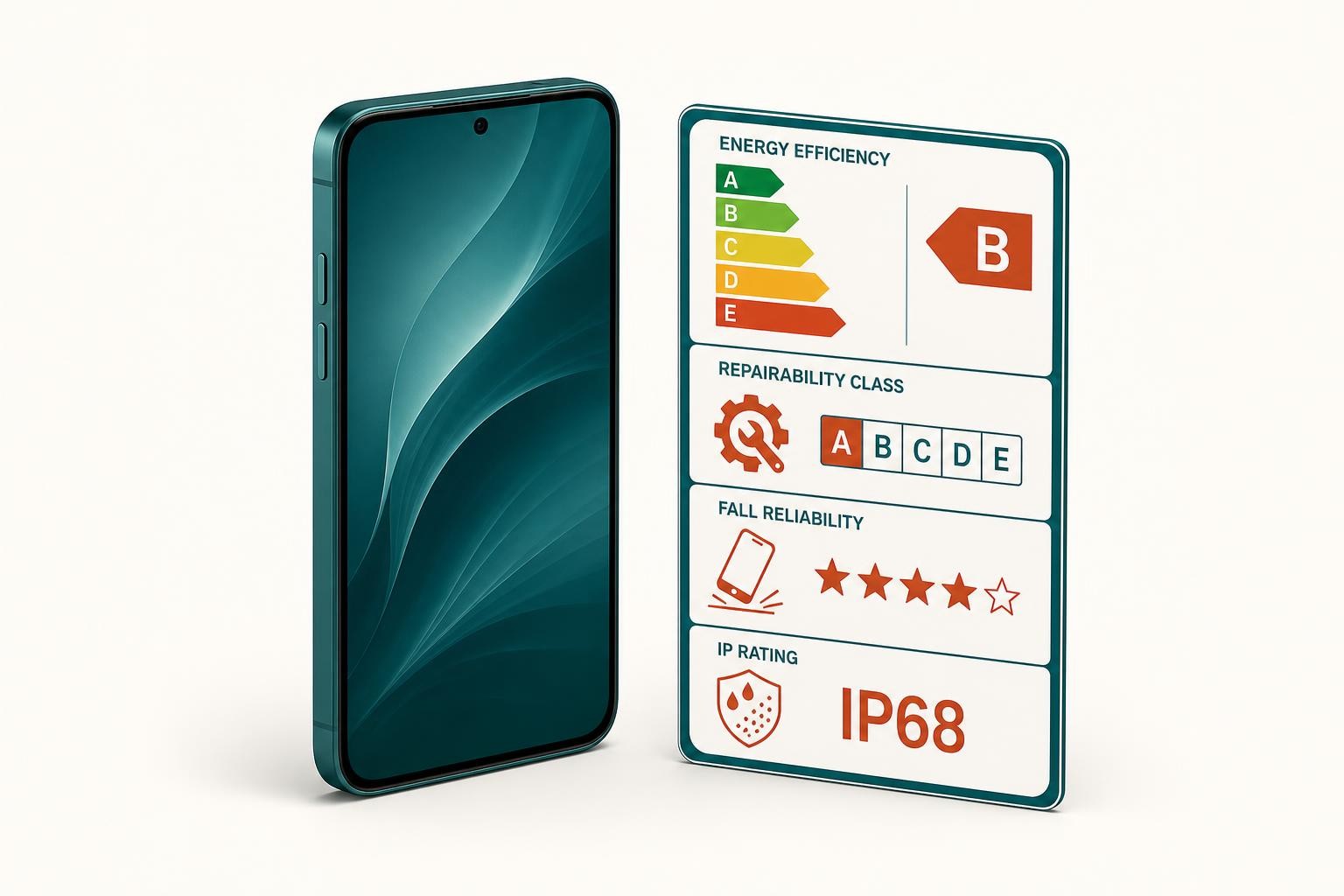
The repairability class is calculated from a repairability index that factors in spare-parts availability, tool requirements, disassembly complexity, and access to repair information. This is the first EU-wide standardised assessment of product repairability for any product group. Products must also be registered in the EPREL database (the European Product Registry for Energy Labelling) before first placement on the market, with the QR code on the label linking directly to the product's EPREL entry.
The numbers behind the regulation
The 2024 Ecodesign Impact Accounting report projects consumer expense savings of approximately €20 billion by 2030 - equivalent to around €98 per EU household - driven primarily by lower acquisition costs as devices last longer. On the energy side, the combined regulations are projected to save 2.2 TWh of electricity per year by 2030, a 31% reduction compared to a scenario without measures. When production-phase savings are included, total primary energy savings reach 8.1 TWh by 2030.
Where the rules fall short - a balanced read
The regulation is a genuine step forward. It is also, in the view of repair advocates, an incomplete one.
Right to Repair Europe has highlighted several gaps. Only five of the 15 mandated spare-part types are accessible to end-users; the rest are restricted to professional repairers. A last-minute corrective act removed the requirement for displays to be user-replaceable with basic tools - the final text requires only that displays be replaceable by professionals using commercially available tools in a workshop setting. And if a manufacturer's battery meets the 800-cycle durability threshold, it is not required to make that battery accessible to consumers for self-replacement.
The coalition's concern is that the rules push longevity without mandating truly repairable design. A device can score well on the repairability index while still using adhesive bonding that makes battery replacement impractical for anyone outside a professional workshop. The regulation sets a floor; it does not yet define the ceiling that repair advocates are pushing for.
This is worth noting not as a criticism of the regulation's intent, but as a signal of where the rules are likely to tighten in future review cycles - and where manufacturers who invest in genuinely modular design will have a competitive advantage.
Is your product ready? Use this compliance checker
What this signals for ESPR delegated acts
Regulation (EU) 2023/1670 predates ESPR (Regulation (EU) 2024/1781) and sits under the older Ecodesign Directive 2009/125/EC. But the Commission designed it with the ESPR template in mind, and the structural parallels are deliberate.
Look at what the smartphone regulation contains and you can read the shape of ESPR delegated acts for other product groups:
- A scored repairability class (A-E) - the ESPR Working Plan 2025-2030 explicitly includes horizontal repairability scoring as a measure that will apply across multiple product groups.
- Spare-parts guarantees with defined timelines - the same logic (minimum availability period, tiered delivery windows) will appear in delegated acts for appliances, electronics displays, and other durable goods.
- Information duties that function like a proto-DPP - EPREL registration, publicly accessible repair documentation, spare-part price transparency, and the product information sheet together constitute a structured, machine-readable product record. The ESPR DPP formalises and extends this into a full digital thread.
- Software availability windows - as ESPR delegated acts reach connected products, software-support commitments will become a standard parameter alongside physical durability.
For teams preparing for ESPR delegated acts in textiles, furniture, or other categories: the smartphone regulation is your worked example. The data fields you will need to populate for a DPP - repairability parameters, spare-parts availability, material composition, software support - are already visible here in their earliest form.
The EPREL registration requirement is the closest existing analogue to a DPP. Manufacturers must enter product data — including repairability class, battery endurance, fall-reliability class, and OS update availability — into a central EU registry before first placement on the market. That registry entry is then accessible via QR code on the label. If your team is scoping a DPP implementation, studying the EPREL data model for smartphones is a useful starting point for understanding what structured product-level disclosure looks like in practice.
Preparing for repairability and DPP information duties
The smartphone regulation is in force now. For manufacturers already selling into the EU, the conformity assessment, EPREL registration, and spare-parts commitments are live obligations - not future planning items.
For teams at other manufacturers watching this space: the A-E repairability class, the spare-parts guarantee structure, and the information-disclosure duties are the template. When your product category's delegated act arrives, these are the parameters you will be asked to demonstrate and disclose.
The time to build the data infrastructure - bill-of-materials records, repairability assessments, supplier commitments on spare parts - is before the delegated act is finalised, not after.
Related reading

What Happens to the Digital Product Passport After the First Sale? ESPR and the Second-Hand Market
ESPR's Digital Product Passport is written around the moment a product is placed on the market. But the passport is meant to last a product's whole life. Here's who carries it into resale, what refurbishers and remanufacturers must actually do, and where the obligations genuinely stop.

Your Ecodesign Implementing Regulation Didn't Lapse on 18 July 2024: The ErP-to-ESPR Migration Map
ESPR repealed Directive 2009/125/EC, but your ErP implementing regulations are still binding. Here's the transition map: what the 2026 and 2030 dates actually close, what migration adds, and what to do now.

SCIP Database and ESPR: Why Your DPP Substance Data Is a Different Beast Entirely
You've been filing SCIP notifications since 2021. ESPR's Digital Product Passport doesn't replace that obligation - it demands something structurally different. Here's what changes and what to do now.