ESPR and Tyres: What the 2025-2030 Working Plan Means for Manufacturers, Importers, and Retreaders
Tyres are one of the few product categories that arrive at the ESPR table with a regulatory head start. An EU label already exists, EPREL registration is already mandatory, and the industry has years of standardised test data on rolling resistance, wet grip, and noise. That foundation matters - but it will not be enough. The ecodesign delegated act expected around 2027 will go well beyond what the current label demands, adding durability benchmarks, abrasion-rate limits, material-composition disclosure, and a full Digital Product Passport (DPP). For tyre manufacturers, importers, and retreaders selling into the EU market, the question is not whether to prepare - it is how much runway you have left.
Where Tyres Sit in the ESPR Working Plan
The European Commission adopted the first ESPR Working Plan (COM(2025) 187) on 16 April 2025. The plan covers the period 2025-2030 and identifies six priority product groups for which delegated acts setting ecodesign requirements and DPP obligations will be developed. Tyres - explicitly listed as a final product - sit alongside textiles, furniture, mattresses, iron and steel, and aluminium.
The selection was not arbitrary. Priority product groups were chosen via a Joint Research Centre (JRC) screening, a public consultation in 2023, and the Ecodesign Forum that met in February 2025, ranking products by market size, environmental impact, and potential for improvement. Tyres score highly on all three dimensions: the European tyre market exceeds 350 million units annually, tyre wear is a leading source of microplastic pollution, and the sector already has the testing infrastructure to support rapid regulatory development.
Two Fixed Dates, Then Indicative Ones
Before getting into tyre-specific timelines, it helps to anchor the ESPR calendar. Two dates are fixed in the regulation itself:
- 18 July 2024 - ESPR (Regulation (EU) 2024/1781) entered into force as a framework regulation.
- 19 July 2026 - The first directly applicable obligations take effect, including the ban on destroying unsold textiles and footwear for large enterprises, and the launch of the EU DPP Registry infrastructure.
Everything after that is indicative, not fixed. The Working Plan signals that the tyre delegated act is targeted for adoption around 2027, with DPP application following an 18-24 month transition period - putting mandatory tyre DPP compliance indicatively around 2028-2029. These dates will be confirmed only when the delegated act is published in the Official Journal. Timelines can shift depending on preparatory study completion and stakeholder consultation processes. Treat them as planning anchors, not hard deadlines.
The 2027 delegated-act adoption date and the 2028–2029 DPP application date are indicative targets from the Working Plan — not legally fixed deadlines. Only the dates written into the adopted delegated act will be binding. Monitor the European Commission's Green Forum and Official Journal for confirmation.
How ESPR Builds on the Existing Tyre Label
The EU tyre label, governed by Regulation (EU) 2020/740 (in force since 1 May 2021), already requires suppliers to disclose three performance parameters for C1, C2, and C3 tyres placed on the EU market:
- Fuel efficiency / rolling resistance - graded A to E
- Wet grip - graded A to E
- External rolling noise - graded A to C, with the dB(A) value declared
Every tyre must also carry a QR code linking to its EPREL registration, where a product information sheet is generated automatically. This is, in effect, a proto-DPP: a machine-readable, product-level data record linked to a unique identifier.
Regulation (EU) 2020/740 establishes a framework for harmonised information on tyre parameters through labelling, to allow end-users to make an informed choice when purchasing tyres. The ESPR delegated act will not replace this framework - it will extend it. The existing label data (fuel efficiency, wet grip, noise) is expected to feed directly into the tyre DPP, so the underlying data infrastructure already exists for compliant producers. What the DPP adds is a substantially wider set of lifecycle sustainability dimensions that the current label does not touch.
This is the tyre sector's structural advantage: the testing standards, EPREL workflows, and conformity-of-production procedures built for Regulation 2020/740 provide a genuine head start. No other priority product group in the Working Plan arrives with an equivalent regulatory infrastructure already in place.
Expected Ecodesign Requirements: Beyond the Label
The tyre delegated act has not yet been adopted, so the specific performance thresholds are not yet confirmed. What follows reflects the direction signalled by the Working Plan, the Commission's preparatory work, and the ESPR's general framework. Flag these as expected, not fixed.
Durability and Mileage Benchmarks
ESPR's core logic is extending product lifespans. For tyres, this is likely to translate into minimum mileage or tread-life benchmarks - requiring manufacturers to demonstrate that a tyre meets a minimum durability threshold under standardised test conditions. This is new territory: the current label says nothing about how long a tyre lasts.
Rolling-Resistance Thresholds
The current label grades rolling resistance A to E but does not prohibit any class from being placed on the market. The delegated act is expected to introduce minimum performance floors - effectively banning the lowest-efficiency classes from the EU market, as has happened with energy labels for appliances. Manufacturers already investing in A- and B-class compounds will be better positioned.
Abrasion Rate Limits and Microplastic Disclosure
This is the most consequential new dimension. Tyre wear is estimated to be the most important contributor to unintentionally released microplastics to the environment. According to EU Commission research, microplastic emissions from automotive tyres in the EU 27 equal approximately 450,000 tonnes per year.
The ESPR delegated act for tyres is expected to include requirements related to tyre wear particle emissions - potentially compound requirements that reduce abrasion rates, and/or DPP disclosure of wear-particle emission rates. This aligns with the EU's broader microplastics agenda and with the Zero Pollution Action Plan target to reduce microplastics released into the environment by 30% by 2030.
Material Composition Disclosure
The delegated act is expected to require disclosure of full material composition - natural rubber, synthetic rubber, carbon black, silica, steel, textile reinforcement, and chemical additives - as well as substances of concern, including polycyclic aromatic hydrocarbons (PAHs) in extender oils and vulcanisation chemicals. This is supply-chain data that many manufacturers currently hold internally but do not disclose at product level.
The Microplastics Dimension: ESPR and Euro 7 Together
Tyre wear particles are not just an ESPR issue. They sit at the intersection of two major EU regulatory streams, and understanding both is essential for compliance planning.
The Euro 7 vehicle emission standard, adopted in 2024, represents the world's first legal framework to restrict microplastic releases from tyres. Under Euro 7, specific abrasion requirements for new passenger car tyres (C1) will be introduced from 1 July 2028, with light commercial vehicles following in 2030 and heavier commercial vehicles in 2032. The limits are being developed through the UNECE Working Party on Noise and Tyres, and UNECE estimates that the initial limits could cut overall tyre abrasion by more than 10%.
In 2016, tyre abrasion was estimated to represent 78% of the 1.3 million metric tonnes of microplastics entering the ocean.
The practical implication for tyre manufacturers is a compound regulatory requirement: Euro 7 sets abrasion limits at the vehicle type-approval level (the tyre must perform below a threshold when fitted to a vehicle), while ESPR is expected to address abrasion at the tyre product level - potentially requiring disclosure of wear-particle emission rates in the DPP, and possibly setting minimum compound requirements. These two instruments are complementary, not duplicative, but they will require coordinated test data and documentation strategies.
What the Tyre DPP Will Likely Carry
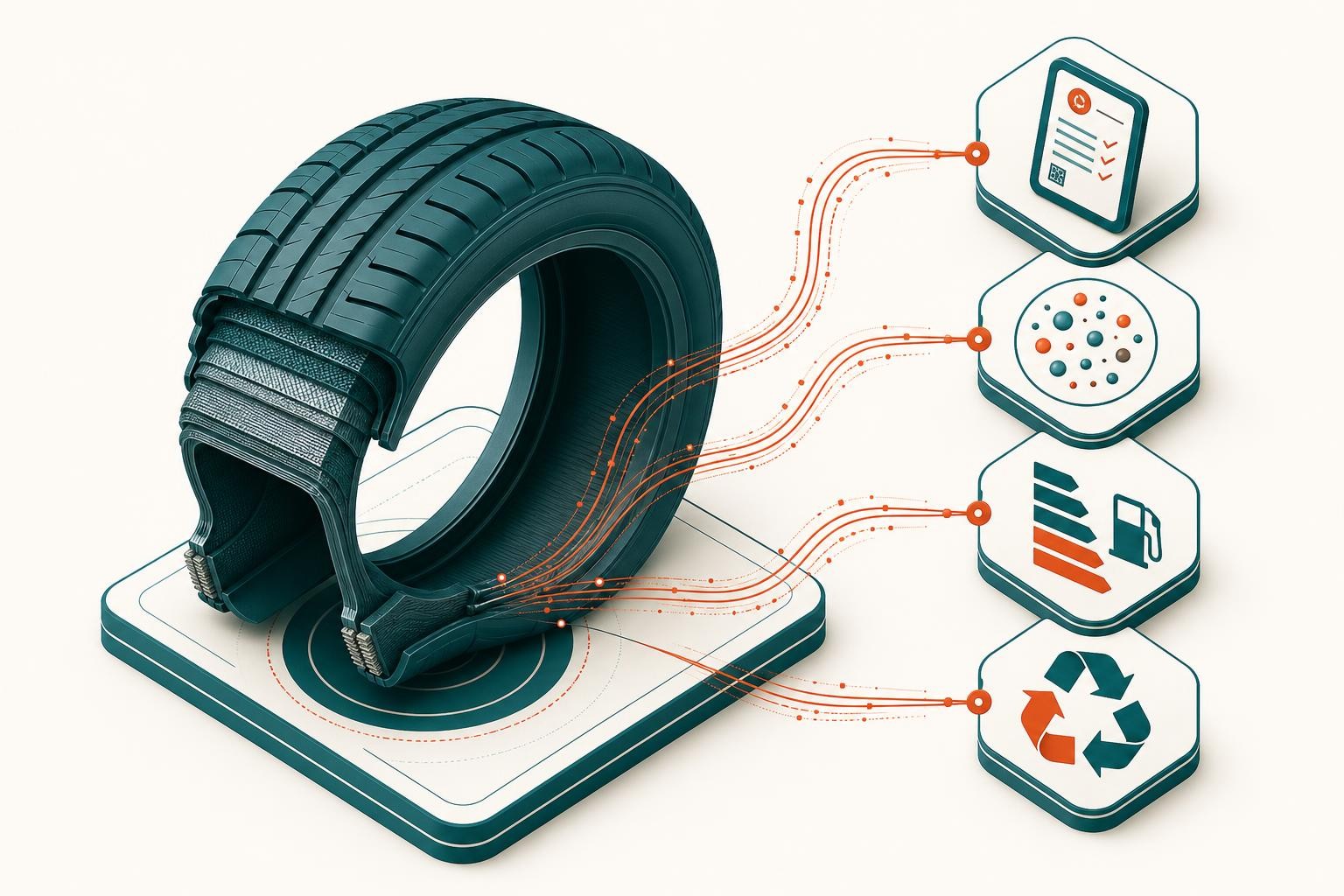
Based on the ESPR framework (Article 9 and Annex III of Regulation (EU) 2024/1781), the Working Plan's direction, and the Commission's preparatory work, the tyre DPP is expected to include the following data categories. These are expected fields, not yet confirmed by a delegated act:
| Data Category | Source / Status |
|---|---|
| Unique product identifier (UPI) | Required under ESPR framework |
| Manufacturer / importer identifier | Required under ESPR framework |
| Tyre label data: fuel efficiency class (A-E) | Already required under Reg. 2020/740 |
| Tyre label data: wet grip class (A-E) | Already required under Reg. 2020/740 |
| Tyre label data: external rolling noise (dB, class) | Already required under Reg. 2020/740 |
| Full material composition (rubber, carbon black, silica, steel, textiles, additives) | Expected - new requirement |
| Substances of concern (PAHs, vulcanisation chemicals) | Expected - new requirement |
| Abrasion rate / wear-particle emission data | Expected - new requirement |
| Recycled content (% by material type) | Expected - new requirement |
| Carbon footprint (lifecycle) | Expected - new requirement |
| Retreadability assessment | Expected - new requirement |
| End-of-life routing information | Expected - new requirement |
The DPP will be linked to the physical tyre via a data carrier - a QR code or RFID/NFC tag - and must remain accessible throughout the tyre's lifecycle, including after retreading. For retreaders, this raises a specific question the delegated act will need to resolve: whether a retreaded tyre requires a new DPP or whether the original tyre's DPP can be updated to reflect the retreading process. The Commission's preparatory work has flagged retreading as a circular economy priority - retreading extends tyre life and reduces raw material consumption, which aligns directly with ESPR objectives.
A Practical "Start Now" Checklist
The delegated act is not yet adopted, but the data you will need to populate a tyre DPP is knowable today. The gap between what you currently collect and what the DPP will require is the compliance risk. Here is where to focus:
Beyond the widget, here are the practical priorities:
1. Audit your EPREL registrations. Every tyre placed on the EU market must already be registered. If your EPREL data is incomplete or out of date, fix it now - this is the foundation the DPP will build on.
2. Map material composition at SKU level. The DPP will require granular composition data - not just "natural rubber and synthetic rubber" but percentages by material type, including carbon black, silica, steel cord, textile reinforcement, and chemical additives. This data often sits in R&D or procurement systems and has never been structured for external disclosure.
3. Engage suppliers on substances of concern. PAHs in extender oils and vulcanisation chemicals are the most likely substances of concern for tyres. You need supplier declarations, not just assurances.
4. Start measuring or modelling abrasion rates. Euro 7 will require abrasion testing from 2028 for C1 tyres. The ESPR DPP is expected to require abrasion rate disclosure. If you are not already running abrasion tests or building models, now is the time to start - the testing infrastructure is still being developed at UNECE level, and early movers will have an advantage.
5. Assess retreadability by casing type. If you manufacture or import tyres, document which casings are designed and suitable for retreading. This is both a DPP field and a circular economy signal that regulators will look for.
6. Build a lifecycle carbon footprint. This does not need to be a full ISO 14040/44 LCA immediately, but you need a credible methodology and product-level data. The DPP will require it.
The Bottom Line for the Tyre Sector
Tyres are well positioned for ESPR - but "well positioned" is not the same as "ready." The existing label and EPREL infrastructure give the sector a genuine head start that no other priority product group enjoys. The testing standards developed for rolling resistance and wet grip under Regulation 2020/740 can be leveraged directly for ecodesign performance requirements.
What the sector is not ready for - at least not at scale - is the lifecycle data layer: material composition at SKU level, abrasion rates, recycled content, carbon footprint, and retreadability assessments. That data exists in fragments across R&D, procurement, and operations. The DPP requires it to be structured, verifiable, and machine-readable.
The ESPR Working Plan schedules the tyre delegated act for indicative adoption in 2027, with DPP compliance following an 18-24 month transition period. That is a shorter runway than it sounds. Preparatory studies, stakeholder consultations, and the delegated act drafting process are already underway. The manufacturers and importers who begin structuring their product data now will spend 2027 validating a system - not building one from scratch under deadline pressure.
The regulatory direction is clear. The data requirements are largely knowable. The time to act is now.
Related reading

What Happens to the Digital Product Passport After the First Sale? ESPR and the Second-Hand Market
ESPR's Digital Product Passport is written around the moment a product is placed on the market. But the passport is meant to last a product's whole life. Here's who carries it into resale, what refurbishers and remanufacturers must actually do, and where the obligations genuinely stop.

Your Ecodesign Implementing Regulation Didn't Lapse on 18 July 2024: The ErP-to-ESPR Migration Map
ESPR repealed Directive 2009/125/EC, but your ErP implementing regulations are still binding. Here's the transition map: what the 2026 and 2030 dates actually close, what migration adds, and what to do now.

SCIP Database and ESPR: Why Your DPP Substance Data Is a Different Beast Entirely
You've been filing SCIP notifications since 2021. ESPR's Digital Product Passport doesn't replace that obligation - it demands something structurally different. Here's what changes and what to do now.