ESPR Ecodesign Requirements Explained: What the Rules Actually Demand
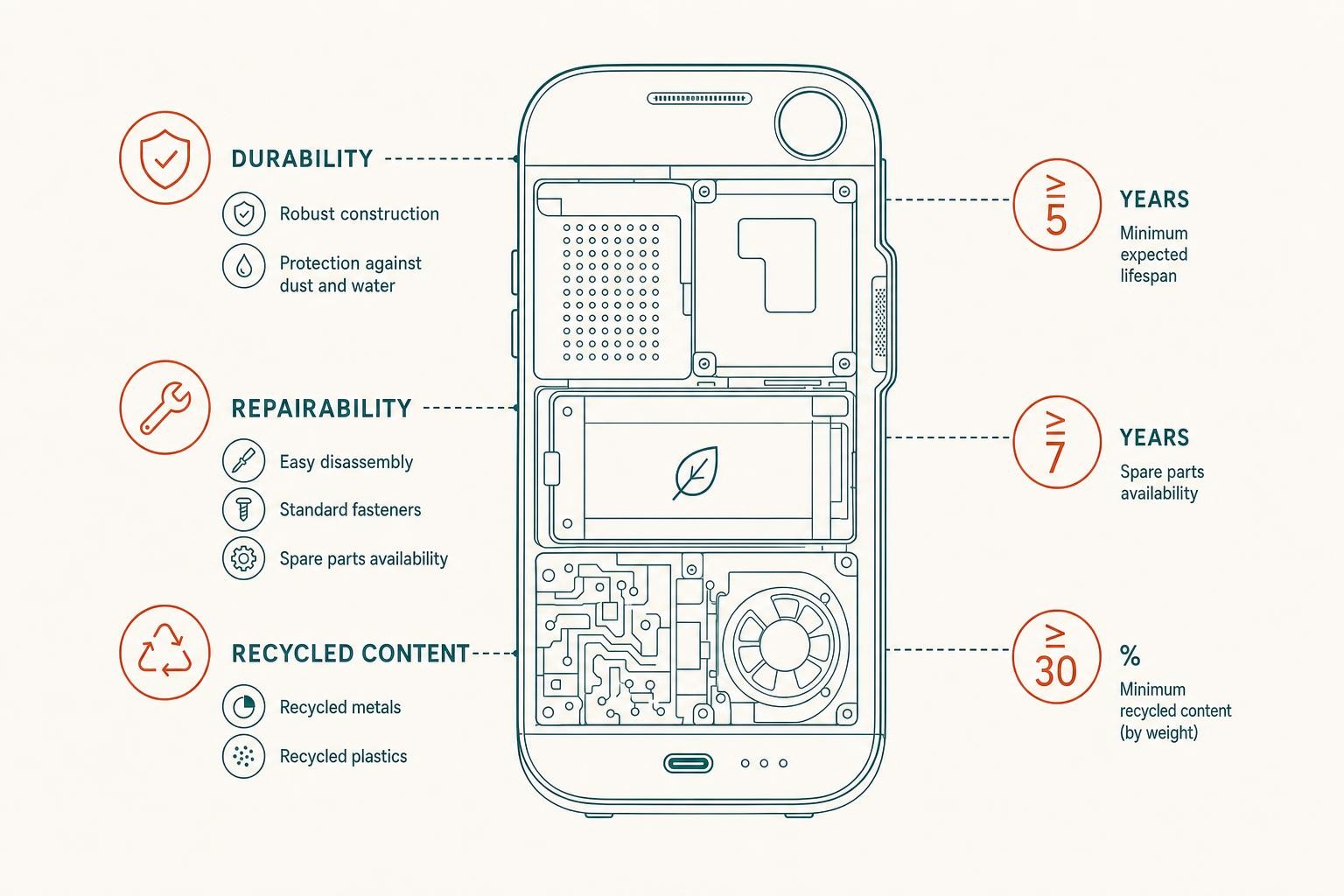
Most conversations about ESPR start with which products are in scope and when obligations arrive. Far fewer explain what the rules will actually demand of a product once its delegated act is adopted. That gap matters: you cannot plan a design programme, a supplier conversation, or a data-collection project if you do not know what you are designing, sourcing, or collecting data for.
This post focuses on the substance - the menu of requirements ESPR can impose, how they become binding, and what the three most-discussed parameters (durability, repairability, and recycled content/recyclability) actually mean in practice.
ESPR is a framework, not a product rule
Regulation (EU) 2024/1781 entered into force on 18 July 2024, replacing Directive 2009/125/EC. Where the old directive covered only energy-related products, ESPR extends to almost all physical goods sold in the EU.
The critical structural point is this: ESPR's headline obligations - ecodesign performance and information requirements, a Digital Product Passport, and a ban on destroying unsold consumer goods - become binding for a product category only once the Commission adopts the relevant delegated act. Until a delegated act is published for a category, no category-level ESPR obligations are in force.
Delegated acts are product-specific legal instruments adopted by the Commission under ESPR's authority. They set the concrete, enforceable requirements for individual product categories - the numbers, the data fields, the timelines. The framework regulation itself defines the types of requirements that delegated acts may impose; it does not set the thresholds.
Two categories of requirement
ESPR delegates the specifics to product-level delegated acts, but the regulation defines two categories of requirements those acts can impose. Performance requirements set minimum thresholds products must meet - covering parameters such as durability, reusability, repairability, energy and resource efficiency, recycled content, carbon footprint, and restrictions on substances that inhibit circularity.
Information requirements complement performance requirements; they must include, as a minimum, requirements related to the Digital Product Passport and to Substances of Concern. In practice, the DPP is the primary vehicle for information requirements: it makes a product's composition, environmental performance, repairability data, and compliance status machine-readable and accessible to consumers, repairers, recyclers, and authorities.
ESPR's Annex I lists approximately 20 product parameters from which delegated acts can draw performance requirements, including durability, ease of repair and maintenance, ease of upgrading, design for recycling, use or content of recycled materials, and incorporation of used components.
Not every parameter applies to every product. Each delegated act selects the parameters most relevant to that product group's environmental impact and sets the specific thresholds or scoring methods. This is why requirements will differ substantially between, say, a textile and a piece of industrial equipment.
Durability: designed to last
Durability is one of the most fundamental parameters in Annex I. Products must be designed to last longer, reducing premature replacement and waste. ESPR evaluates mechanical, chemical, and functional lifespans based on intended use.
These three dimensions are distinct. Mechanical durability concerns resistance to physical stress - wear, impact, fatigue. Chemical durability addresses degradation from exposure to substances, UV radiation, or humidity. Functional durability is about whether the product continues to perform its intended purpose over time, including resistance to premature obsolescence driven by software or firmware.
ESPR enables requirements to prevent premature obsolescence due to unreliable design, barriers to repair, and lack of software updates. This last point is significant for connected products: a device that stops receiving security patches may become functionally obsolete long before it fails mechanically.
What durability thresholds will look like in practice depends entirely on the delegated act for each product group. A delegated act might specify a guaranteed service life in years, a minimum number of operational cycles, or test standards a product must pass. None of these numbers exist at the framework level - they are set product by product.
Repairability: access, disassembly, and scoring
Repairability is where ESPR introduces some of its most operationally demanding requirements. ESPR places particular emphasis on repairability. Delegated acts may require manufacturers to provide spare parts for a minimum number of years after the last unit is placed on the market, to make repair manuals available to independent repairers, and to achieve a minimum repairability score. The repairability score methodology is being developed by the Commission and will be specified in delegated acts.
Products must be designed to allow for easy disassembly and reassembly, making it simpler to access and replace components. Manufacturers will be obligated to make spare parts available to consumers and repair professionals. Providing access to repair manuals and diagnostic tools is essential to facilitate repair.
The repairability score is an A-to-E rating. It assesses how easy a product is to repair, calculated using parameters such as the availability of spare parts, access to technical documentation, ease of disassembly, and the guaranteed duration of software updates. The method takes into account key product components ('priority parts') and various factors that influence repairability, such as the steps needed for disassembly, the tools needed to access the components for replacement, and the extent to which spare parts and repair information are available.
Since 20 June 2025, new EU regulations require smartphones and tablets to display a repairability label with grades from A (most repairable) to E (least repairable) - an early, product-specific implementation of the repairability scoring concept.
The horizontal repairability rule
Beyond product-specific delegated acts, the first ESPR Working Plan (adopted 16 April 2025) includes a horizontal repairability requirement. The plan introduces two horizontal requirements that cut across multiple product groups: repairability rules targeted for 2027, potentially covering consumer electronics and small household appliances; and recycled content and recyclability requirements for electrical and electronic equipment, targeted for 2029.
It is important to be precise about what "2027" means here. The Working Plan indicates a horizontal repairability requirement for 2027, with product scope still to be determined, and an indication that it could include consumer electronics and small household appliances. That is an indicative adoption year for the delegated act - not a compliance deadline. Delegated acts typically provide 18 to 36 months between publication and the compliance deadline. The exact scope and thresholds will emerge from the preparatory study and Ecodesign Forum consultations that precede the act.
The 2027 date for the horizontal repairability rule is indicative — it is the Commission's target for adopting the delegated act, not the date by which products must comply. Compliance deadlines follow adoption by 18–36 months. Treat it as a planning horizon, not a hard deadline.
Recycled content and recyclability
These two parameters are closely related but legally distinct. Recycled content requirements set a minimum percentage of recycled material that must be incorporated into a product or a specific component. Recyclability requirements govern how a product is designed so that its materials can be recovered at end of life.
Recyclability requires products to be designed for end-of-life recovery, including separation of materials, labelling for recyclers, and minimising mixed-material assemblies that hinder circularity. Delegated acts may set minimum percentages of recycled content for specific materials in a product. This requirement is particularly significant for plastics, metals, and textiles, where the Commission has identified significant opportunities to increase recycled content.
The first ESPR Working Plan includes a horizontal measure on recycled content and recyclability of electrical and electronic equipment, with an indicative adoption year of 2029.
This second horizontal measure will address recyclability and the use of recycled content in electrical and electronic equipment, supporting broader goals in resource efficiency and waste prevention. ICT products fall within the scope of these horizontal requirements rather than standing as a separate product group.
As with repairability, the specific thresholds - what percentage of recycled plastic, which materials must be separable, what labelling recyclers require - will be set in the delegated act, not in the framework regulation.
The ban on destroying unsold goods
ESPR also introduces a ban on destroying unsold consumer goods - a form of obligation that sits alongside, but is distinct from, the performance and information requirements described above. The first obligations - including a ban on destroying unsold clothing and footwear - take effect on 19 July 2026 for large companies. This is one of the few ESPR obligations that does not require a delegated act to become binding; it flows directly from the framework regulation itself. It is covered in detail in our separate post on the textiles destruction ban.
How requirements become binding: the delegated act trigger
The practical implication for compliance teams is straightforward: your overall obligations come from the ESPR itself, but the delegated act for your product category is what determines exactly what you need to comply with and when.
The process runs roughly as follows:
The Commission commissions a technical study of the product group, assessing environmental impact, market data, and feasible improvement options across the Annex I parameters.
Stakeholders — manufacturers, importers, NGOs, Member State experts — are consulted on the draft requirements. The Commission must take their views into account.
The Commission adopts the delegated act, specifying which parameters apply, the exact thresholds or scoring methods, and the compliance timeline.
Typically 18–36 months between publication of the delegated act and the date products must comply. This is the window for design changes, supplier engagement, and DPP data assembly.
From this date, products placed on the EU market must meet the requirements. Market surveillance authorities in Member States monitor and enforce.
What this means for your planning
The framework's structure has a practical consequence: you can begin preparing before your delegated act is adopted, because the types of data and design choices that will matter are already known. Durability testing, repairability assessments, recycled content tracking, and DPP data assembly all take time - and most of the underlying data sits with suppliers, not with the manufacturer.
The widget above gives you a quick read on where your gaps are. For a more structured view of what data a DPP will require for your product category, the DPP Readiness Checklist separates what you can act on now from what waits for your delegated act.
The bottom line
ESPR does not regulate products directly. It creates a legal architecture - a menu of up to ~20 parameters, two categories of requirement (performance and information), and a delegated act mechanism that makes obligations binding product group by product group. The three parameters that will affect the widest range of manufacturers are durability (mechanical, chemical, and functional lifespan), repairability (spare parts, disassembly, repair information, and a scored A-E rating), and recycled content/recyclability (minimum percentages and design-for-recovery rules). Horizontal delegated acts for repairability and for recycled content in electrical and electronic equipment are indicatively targeted for 2027 and 2029 respectively - but those are adoption targets, not compliance deadlines.
The exact thresholds for your product will only be known once your delegated act is published. What you can do now is understand the parameter types, map your current data gaps, and start the supplier conversations that will take the longest to resolve.
Related reading

What Happens to the Digital Product Passport After the First Sale? ESPR and the Second-Hand Market
ESPR's Digital Product Passport is written around the moment a product is placed on the market. But the passport is meant to last a product's whole life. Here's who carries it into resale, what refurbishers and remanufacturers must actually do, and where the obligations genuinely stop.

Your Ecodesign Implementing Regulation Didn't Lapse on 18 July 2024: The ErP-to-ESPR Migration Map
ESPR repealed Directive 2009/125/EC, but your ErP implementing regulations are still binding. Here's the transition map: what the 2026 and 2030 dates actually close, what migration adds, and what to do now.

SCIP Database and ESPR: Why Your DPP Substance Data Is a Different Beast Entirely
You've been filing SCIP notifications since 2021. ESPR's Digital Product Passport doesn't replace that obligation - it demands something structurally different. Here's what changes and what to do now.